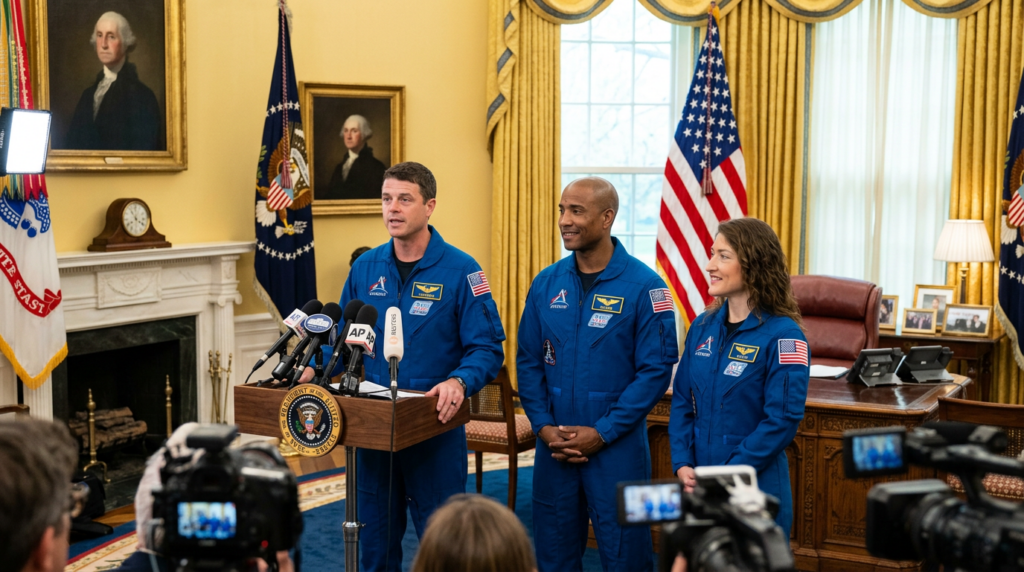
President Donald Trump welcomed the four-member crew of NASA’s Artemis II mission to the Oval Office on April 29, celebrating the most ambitious human spaceflight achievement since the Apollo era. Commander Reid Wiseman, pilot Victor Glover, mission specialists Christina Koch and Jeremy Hansen joined NASA Administrator Jared Isaacman for the roughly 22-minute event the White House described as a greeting.
The mission launched April 1 and ended with a Pacific Ocean splashdown on April 10. The Orion spacecraft — its capsule named Integrity — carried the crew 252,756 miles from Earth while orbiting around and back from the moon, breaking the Apollo 13 record of 248,655 miles set in 1970. It marked the first time humans had traveled beyond low Earth orbit since the Apollo 17 crew in December 1972.
The mission produced multiple historic firsts. Wiseman became the oldest person to travel beyond low Earth orbit. Glover became the first person of color to journey to the moon. Koch became the first woman to make that voyage. Hansen of the Canadian Space Agency was the first non-U.S. citizen to reach the moon. During the flyby, the crew spent more than six hours documenting the far side of the moon — previously observed only by robotic missions — and witnessed a total solar eclipse from space.
Trump praised the crew during the briefing, calling them people of unbelievable courage who had captivated the world. The astronauts stood silently while reporters directed most questions at the president on unrelated topics, drawing a public rebuke from the White House rapid response team. Isaacman said NASA is on track to launch Artemis III in 2027, with Artemis IV targeting a crewed south-pole landing in 2028.
South Carolina carries deep ties to the program. Lancaster native Charles Duke became the tenth person to walk on the moon as lunar module pilot of Apollo 16 in April 1972, and served as the voice of Mission Control during the Apollo 11 landing. Workers at Boeing’s North Charleston plant contributed manufacturing labor to the Space Launch System rocket that powered Artemis II, linking Lowcountry workers directly to the record-breaking mission.