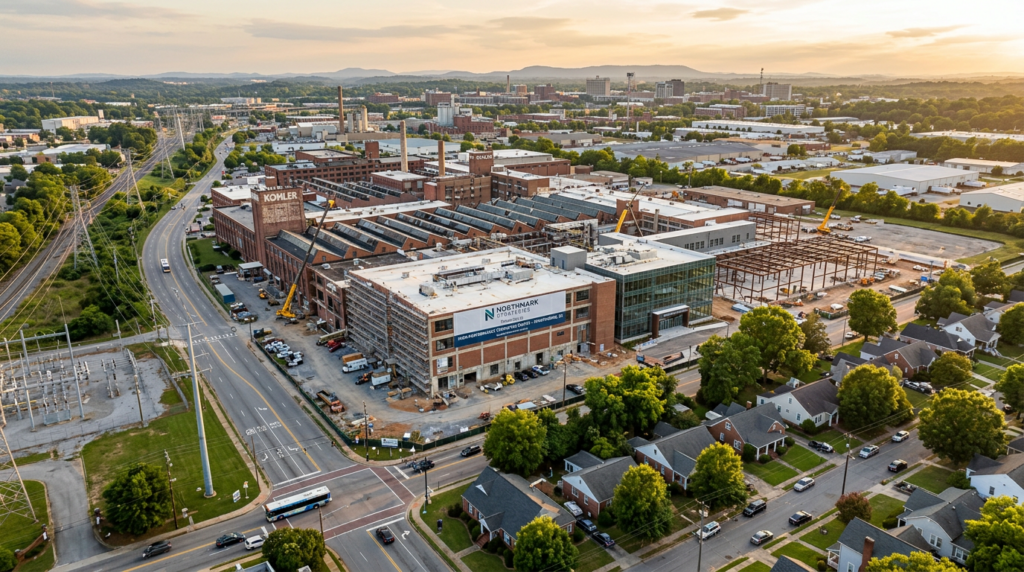
Some Spartanburg County residents say they were deceived about the scale and nature of the $2.8 billion NorthMark Strategies project rising on the former Kohler plant site along South Pine Street, after the company applied to South Carolina regulators for a major increase in on-site power generation. The tension surfaced at a community forum Thursday night in Cleveland Park, where neighbors questioned how a project pitched to County Council last year as a high-performance computing center is now described publicly by NorthMark as a data center.
The pushback comes months after Spartanburg County Council voted down a different data center proposal but approved this one — originally negotiated under the working name Project MOC-1 — with a fee-in-lieu-of-tax agreement that drops the assessment ratio from the 6% manufacturing rate to 4% for 40 years, plus $15 million in special source revenue credits over the first two decades and $2 million annually for the next twenty, according to filings and reporting on the deal. The agreement, finalized in 2025, was framed at the time by Secretary of Commerce Harry Lightsey as a boost to South Carolina’s technology sector and stands as the second-largest single investment in state history. NorthMark president Jen Byrne has said publicly that Spartanburg beat out more than 100 other locations evaluated nationwide.
Construction is now underway at the Kohler site, which closed in 2024 after 66 years. The renovation is planned in three phases, ending with the 500,000-square-foot former manufacturing plant being converted to computing use. Despite the investment scale, NorthMark has committed to only 27 full-time positions and has not disclosed the salary range or job mix for those roles.
Cleveland Park resident Nancy Garner said publicly at the forum that she feels deceived by the county council and by former councilman David Britt, who supported the project, calling the facility a data center planted in the middle of her neighborhood. Britt, who championed the deal at the council level, was appointed earlier this year as one of South Carolina’s Public Service Commissioners and said he could not comment on the project because of his new regulatory position. Britt has previously stated that NorthMark would tap a nearby natural gas line to generate its own electricity rather than draw on the regional grid, and that the facility was expected to use no more energy than Kohler did.
That on-site power model is now central to the controversy. NorthMark filed an application with the South Carolina Department of Environmental Services in March asking to increase the project’s permitted power generation capacity. SCDES has confirmed publicly that the filing reflects a proposal to increase power generation capacity but said it cannot yet disclose the size of the request. If the agency advances the application, it would trigger a public comment period of at least 30 days. The Southern Environmental Law Center, which raised pollution concerns about the original permit last year, says its concerns are growing. NorthMark told regulators it plans to voluntarily implement continuous emissions monitoring, with real-time data shared with state and federal regulators, and the company maintains that the facility will not affect the regional power grid.
The local impact runs along South Pine Street into established neighborhoods, where residents including Robyn Anderton said they felt unheard at the original County Council meeting and questioned why elected representatives would vote against what their constituents wanted. The new SCDES filing means the next round of decisions on the project’s footprint will play out at the state regulatory level rather than at the county council, even as the council members who approved the deal still face questions from constituents at the neighborhood level.