BMW has warned investors to expect a notable decline in its 2026 earnings, citing ongoing tariff pressures and slowing demand in China — and the company's financial disclosures specifically name the Spartanburg, South Carolina plant as a key factor in how it is navigating those headwinds. The German automaker projected that higher tariffs will deliver a 1.25 percentage-point blow to its core automotive margin in 2026, which it now expects to land between 4 and 6 percent — down from 5.3 percent in 2025 and 6.3 percent in 2024. Group earnings before tax fell to 10.2 billion euros in 2025, and BMW expects that figure to decline by an additional 5 to 10 percent in 2026.
At the same time, the company confirmed that delivery volumes for 2026 are expected to remain flat compared to 2025 levels. The outbreak of the U.S.-Iran conflict has added new strain on top of existing tariff challenges, driving up fuel prices and introducing fresh supply chain uncertainty — particularly in the Middle East, a key market for BMW's premium vehicles.
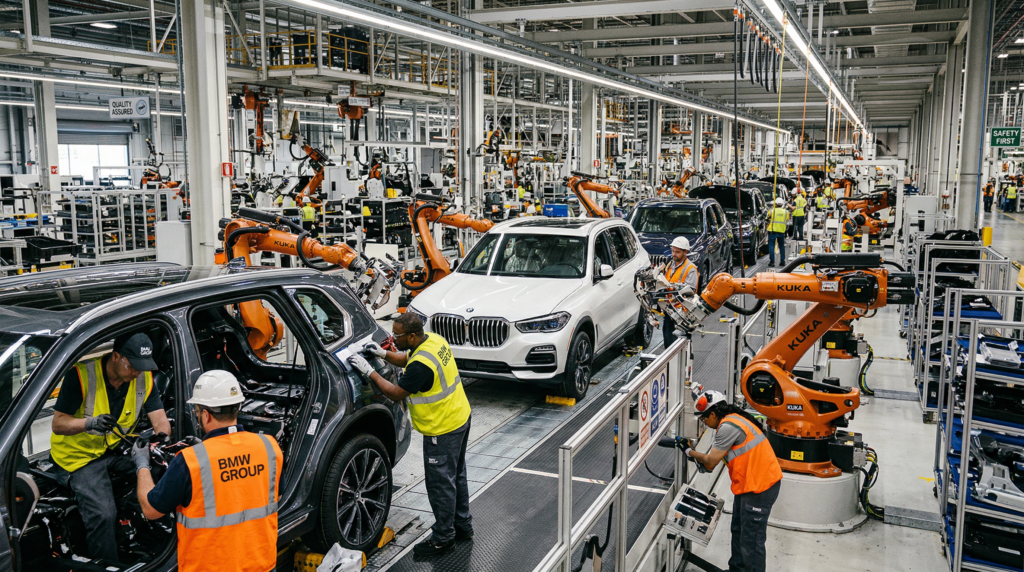
For Spartanburg County, BMW's Greer plant is not a peripheral concern — it is the economic anchor of the region. The plant is the largest BMW manufacturing facility in the world by volume, producing vehicles including the X3, X4, X5, X6, X7, and XM models. It employs more than 11,000 workers directly and supports thousands more jobs through a dense network of suppliers and logistics providers operating across Spartanburg County.
In its filings, BMW acknowledged that its U.S. production footprint — centered on the Spartanburg plant — has “cushioned the blow” of U.S. tariffs, since vehicles built domestically are not subject to the same import levies as those shipped from Germany or other international facilities. That manufacturing presence in South Carolina has been a strategic asset for BMW as the global trade environment has grown more complex. However, BMW still faces EU tariffs on its Chinese-made electric Mini, and the escalating cost environment — including surging diesel costs affecting logistics — is squeezing margins industry-wide.
For the roughly 11,000 Spartanburg County workers who earn their livelihoods at the Greer plant, and for the county's economic development pipeline that has attracted $3.5 billion in capital investment partly on the strength of the BMW ecosystem, the company's cautious 2026 outlook is worth watching. A 5 to 10 percent decline in earnings at a company this size can translate into hiring freezes, reduced overtime, or scaled-back supplier contracts — ripple effects that reach far beyond the plant gates off Highway 101 in Greer.
Spartanburg County has diversified its manufacturing base significantly over the past decade, with Michelin North America, Milliken & Company, and hundreds of German and European suppliers operating alongside BMW. But BMW remains the cornerstone of the county's identity as a global manufacturing destination — and its health is inseparable from the health of the local economy.
What's Happening
When and where is this happening?
BMW issued its 2026 financial guidance in March 2026. The projected earnings decline and margin pressure are expected to play out through the full 2026 calendar year. BMW's primary U.S. facility is the Greer plant in Spartanburg County.
Who is involved?
BMW Group, the German automaker, is the subject of the earnings warning. The Greer, South Carolina plant — the company's largest globally by production volume — is specifically cited in BMW's filings as a factor in cushioning U.S. tariff exposure.
Why does this matter to Spartanburg?
The BMW plant in Greer is Spartanburg County's largest private employer, with more than 11,000 direct employees and a deep supplier network. BMW's financial health directly affects jobs, county tax revenue, and the broader manufacturing economy.
What should residents know?
BMW has not announced layoffs or plant reductions. The guidance reflects a difficult external environment — tariffs, Middle East conflict, and China market softness — rather than problems specific to the Spartanburg facility.
What happens next?
BMW will report first-quarter 2026 results in the coming weeks. Investors and local officials will be watching whether the company's U.S. production advantage continues to shield Spartanburg from the worst of the global pressure.