Two days after the United States Navy launched its blockade of the Strait of Hormuz, the standoff between Washington and Tehran is intensifying — and the pressure is already reaching Spartanburg’s manufacturing economy in the form of elevated energy and logistics costs.
The U.S. naval blockade, announced April 13 following the collapse of peace talks in Islamabad, has drawn a sharp response from China, whose Defense Ministry warned that the Strait of Hormuz is open to Chinese shipping. According to Democracy Now and Bloomberg reports from April 14 and 15, at least four Iran-linked vessels crossed the strait in the first 24 hours of the blockade, raising questions about the policy’s effectiveness. China’s position is that existing trade and energy agreements with Iran take precedence over the U.S. blockade order.
A ceasefire between the U.S. and Iran — the terms of which limited hostilities over the past several weeks — expires April 22. Both the U.S. and Iran have indicated that a second round of peace talks could resume as early as this week, though no date had been set as of April 15, according to reports from Reuters and the Associated Press.
The Strait of Hormuz is the world’s single most critical oil chokepoint, with roughly 20 percent of global petroleum passing through it daily. Elevated prices and shipping uncertainty are being watched closely by Spartanburg’s largest industrial employers.
BMW Manufacturing in Greer, which is Spartanburg County’s largest private employer with more than 11,000 workers, is exposed to energy cost volatility through the diesel, natural gas, and logistics fuel that powers the plant’s operations and supply chain. BMW’s parent company already warned earlier this month of a projected 5-to-10 percent earnings decline for 2026, citing tariff pressures and China market softness. Energy cost increases would add to that pressure.
Michelin’s North American headquarters in Greenville and its Spartanburg-area manufacturing operations are also sensitive to oil price movements, given that synthetic rubber — the primary raw material in tire manufacturing — is a petroleum derivative.
The broader South Carolina economy entered a softer stretch in late 2025, with the state shedding jobs in logistics and manufacturing sectors according to TD Economics. Analysts are projecting 2.5 percent GDP growth for South Carolina in 2026, but that forecast was made before the current round of escalating Iran tensions.
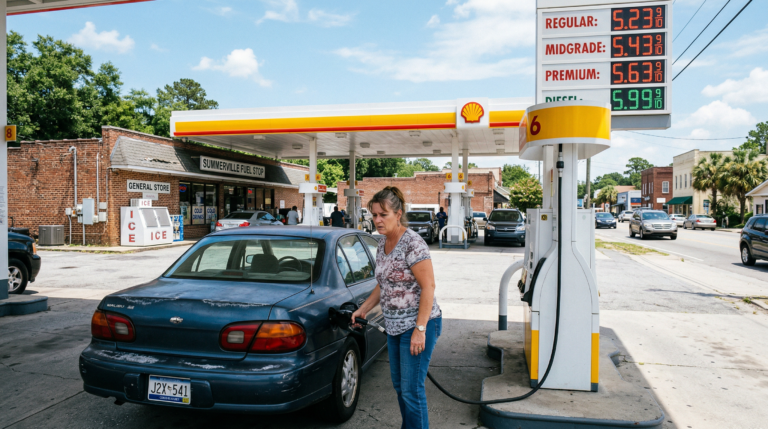
For Spartanburg residents, the most immediate effect of the ongoing crisis has been elevated gas prices. Average regular unleaded prices in Spartanburg had already climbed this spring alongside national trends driven by earlier oil market volatility, and sustained disruption in the Strait of Hormuz could push prices higher in the coming weeks.
What’s Happening
Q: What is happening with the Strait of Hormuz blockade?
A: The United States Navy launched a blockade of the Strait of Hormuz on April 13 following the collapse of U.S.-Iran peace talks in Islamabad. China has challenged the blockade, and Iran-linked vessels have continued crossing the strait.
Q: How does this affect Spartanburg?
A: Spartanburg’s major employers — including BMW Manufacturing and Michelin — depend on stable energy and logistics costs. Elevated oil prices tied to Hormuz tensions raise operating costs for the county’s large manufacturing sector.
Q: Will the blockade cause gas prices in Spartanburg to rise?
A: Sustained disruption in the Strait of Hormuz, which handles roughly 20 percent of global daily oil supply, could push gas prices higher in Spartanburg and across the Upstate if the standoff continues.
Q: Could the situation be resolved soon?
A: The U.S. and Iran have signaled they may resume peace talks as early as this week. The ceasefire expires April 22, making the next several days critical for determining the trajectory of the conflict.
Q: What is the broader economic impact on South Carolina?
A: South Carolina’s economy had already entered a softer patch in late 2025 with job losses in logistics and manufacturing. Escalating energy costs from the Hormuz standoff add another layer of uncertainty for the state’s trade-exposed industries.