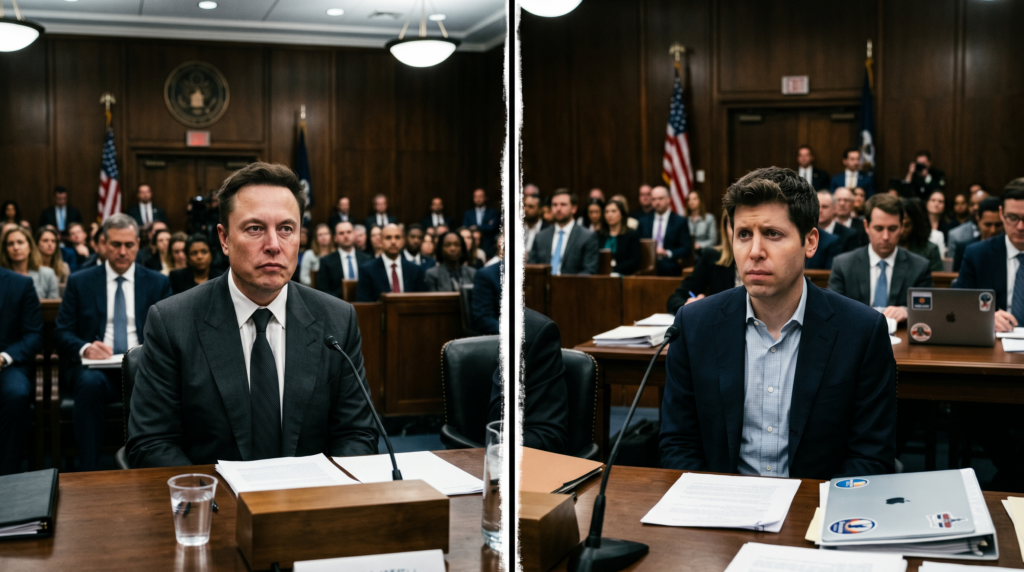
Elon Musk narrowed the scope of his long-running lawsuit against OpenAI and its leadership on the eve of trial last week, dropping his fraud and constructive fraud claims and leaving just two allegations to go before a jury. U.S. District Judge Yvonne Gonzalez Rogers of the Northern District of California agreed to Musk’s request to streamline the case, which had originally contained 26 claims when Musk filed his complaint in November 2024.
Jury selection began Monday in federal court in Oakland, California, with opening arguments to follow. The trial will focus on two remaining claims — unjust enrichment and breach of charitable trust — against OpenAI, CEO Sam Altman, company President Greg Brockman, and major backer Microsoft. All defendants have denied wrongdoing, calling the suit baseless harassment by a competitor seeking to slow them down.
Musk co-founded OpenAI as a nonprofit in 2015 alongside Altman and others, contributing roughly $38 million and strategic guidance before leaving the board in 2018. He alleges the organization betrayed its founding mission of developing artificial intelligence for humanity’s benefit when it accepted billions in investment from Microsoft and began restructuring as a for-profit company. OpenAI counters that Musk was aware of and had consented to a for-profit direction as early as 2017, and that his lawsuit reflects a commercial rivalry after he launched his own AI venture, xAI, in 2023.
Should Musk prevail, he is asking the court to direct as much as $134 billion in damages to OpenAI’s charitable arm, restore the company’s status as a nonprofit research organization, and remove Altman and Brockman from their positions. The trial is structured in two phases: a jury will first hear evidence and issue a non-binding advisory verdict, after which Judge Gonzalez Rogers will rule on both liability and the remedies Musk seeks.
OpenAI had complained to the judge two weeks before the trial opened that Musk’s proposed remedies amounted to an 11th-hour surprise, accusing him of a legal ambush. Musk’s camp said narrowing the case to the two core claims would help jurors focus on the central argument — that OpenAI abandoned a charitable obligation made to the public when it accepted outside investment and prepared for a potential initial public offering that analysts have pegged at a valuation of up to $1 trillion.
A Debate With Direct Stakes for Spartanburg’s AI Investments
The legal dispute over who controls the direction of artificial intelligence — and whether profit-driven development serves the public good — resonates in Spartanburg County, where major employers and institutions are embedding AI into daily operations.
BMW Manufacturing’s plant on I-85 in Spartanburg County completed the world’s first deployment of humanoid robots at a BMW Group production facility in 2025. Working in partnership with the robotics firm Figure AI, the humanoid robot Figure 02 helped produce more than 30,000 BMW X3 vehicles over ten months, moving more than 90,000 components and logging approximately 1,250 hours of operating time during ten-hour daily shifts. The results were strong enough that BMW used the Spartanburg pilot as the blueprint for its new Physical AI program, which is now being extended to its Leipzig, Germany plant and anchored by a dedicated Center of Competence for Physical AI in Production.
Milliken & Company, headquartered in Spartanburg, has pursued AI-assisted approaches in its materials science research and smart manufacturing operations. The company has described using AI and machine learning to analyze production data, optimize workflows, and anticipate maintenance needs across its specialty chemical and textile manufacturing lines — applications that sit directly in the zone of industrial AI development the Musk-Altman case is ultimately about.
On college campuses nearby, the next generation of AI practitioners is already in training. USC Upstate’s computer science faculty actively researches artificial intelligence, machine learning, computer vision, and natural language processing through the department’s undergraduate research lab. Wofford College offers a dedicated Artificial Intelligence course — COSC 440 — through its computer science program and joined the AI Ready Network in 2025, a Council of Independent Colleges initiative designed to help small liberal arts institutions build campus-wide AI strategy and prepare students for careers in an AI-integrated economy.
Among Spartanburg’s small business community, AI adoption has accelerated in recent years alongside national trends. A nationally representative survey of small businesses found that roughly three-quarters now use AI tools in their operations, with cost savings, time efficiency, and competitive pressure cited as the primary drivers. OneSpartanburg, the county’s economic development organization, has tracked workforce and talent needs across manufacturing, logistics, and professional services — sectors where AI tools are reshaping job requirements at a pace that has outrun training pipelines.
The outcome of Musk v. Altman will not rewrite any of that local investment, but it could affect the governance norms around which AI companies like OpenAI operate. If the court finds that OpenAI’s conversion to a for-profit structure violated a charitable trust, it would establish a precedent for how AI organizations structured as nonprofits can transition — and what obligations they carry when doing so. That debate over mission, accountability, and corporate control is one that employers deploying AI tools in Spartanburg County and academics training students to build them are navigating in real time.