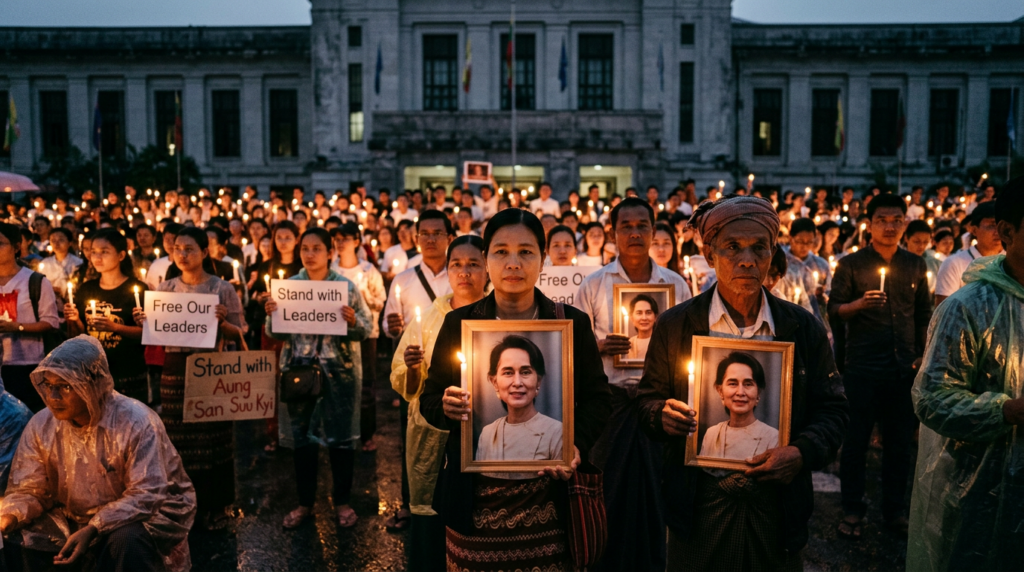
Myanmar’s military government transferred former leader Aung San Suu Kyi from prison to house arrest Thursday, the junta’s state broadcaster announced — a move that international observers have received with guarded skepticism rather than celebration, given the secrecy surrounding her new location and her son’s public statement demanding proof that she is alive.
Suu Kyi, 80, has been held since the military seized power in a February 2021 coup that toppled the civilian government she led. She was sentenced to 27 years in prison on charges her supporters and rights groups describe as fabricated — including corruption, violating COVID-19 restrictions, and illegally importing communication equipment. Thursday’s amnesty, the second applied to her in recent weeks, reduces her sentence to approximately 18 years, with more than 13 years remaining.
The transfer order came from General Min Aung Hlaing, who led the 2021 coup and was recently sworn in as Myanmar’s civilian president following an election that excluded Suu Kyi’s dissolved party, the National League for Democracy. His office said the remaining sentence had been commuted to be served at a designated residence, which the junta has not identified. State media broadcast a photograph of Suu Kyi seated alongside two uniformed officers — the first public image of her in years — but her son Kim Aris said the photo appeared to date to 2022.
Aris, who said he had not received confirmation of his mother’s location or condition from any authoritative source, described the transfer as a calculated gesture designed to ease international pressure rather than a sign of genuine reform. Nay Phone Latt, spokesperson for Myanmar’s parallel anti-junta National Unity Government, told reporters that returning Suu Kyi to house arrest does not confirm she is alive.
The United Nations Secretary-General’s office called the transfer a meaningful step toward a credible political process while reiterating its call for the immediate release of all political prisoners. Myanmar’s civil war, which has engulfed much of the country since the coup, continues alongside the ongoing detention of thousands of political prisoners.
South Carolina’s senators have both addressed the situation in Myanmar through their committee roles. Lindsey Graham, a senior member of the Senate Armed Services Committee, has consistently advocated for conditioning U.S. engagement with military governments on political prisoner releases. The junta’s selective amnesty programs — including one on April 17 that reduced sentences for more than 4,500 inmates — have not satisfied the conditions human rights advocates say would constitute genuine reform.