

News Summary
The spotted lanternfly, an invasive pest from Asia, has been detected in South Carolina, posing a risk to agriculture and forestry sectors. Findings were reported in Greenville and Seneca, prompting Clemson University to call for early detection and rapid response strategies to mitigate damage to crops. The insect, identifiable by its distinct appearance and feeding habits, could significantly impact industries reliant on grapes, fruits, and hardwood trees. Public involvement is crucial for monitoring and controlling the pest’s spread.
Greenville, South Carolina – For the first time, the spotted lanternfly (Lycorma delicatula) has been detected in South Carolina, with findings reported in both Greenville and Seneca. This uninvited insect, native to Asia, poses a significant threat to the state’s agricultural and forestry sectors, according to Clemson University’s Department of Plant Industry (DPI).
Originally spotted in the United States in Pennsylvania in 2014, the spotted lanternfly has since spread across at least 18 states, including neighboring North Carolina, Tennessee, and Georgia. While the insect poses no direct harm to humans or animals, its peculiar feeding habits could lead to extensive damage to economically important crops like grapes, hops, stone fruits, and hardwood trees.
The potential repercussions of this pest’s presence in South Carolina could severely impact industries reliant on such crops, notably the wine, fruit, and ornamental plant sectors. To mitigate the economic and ecological risks associated with the spotted lanternfly, Clemson emphasizes the need for early detection and rapid response strategies.
Identification and Behavior
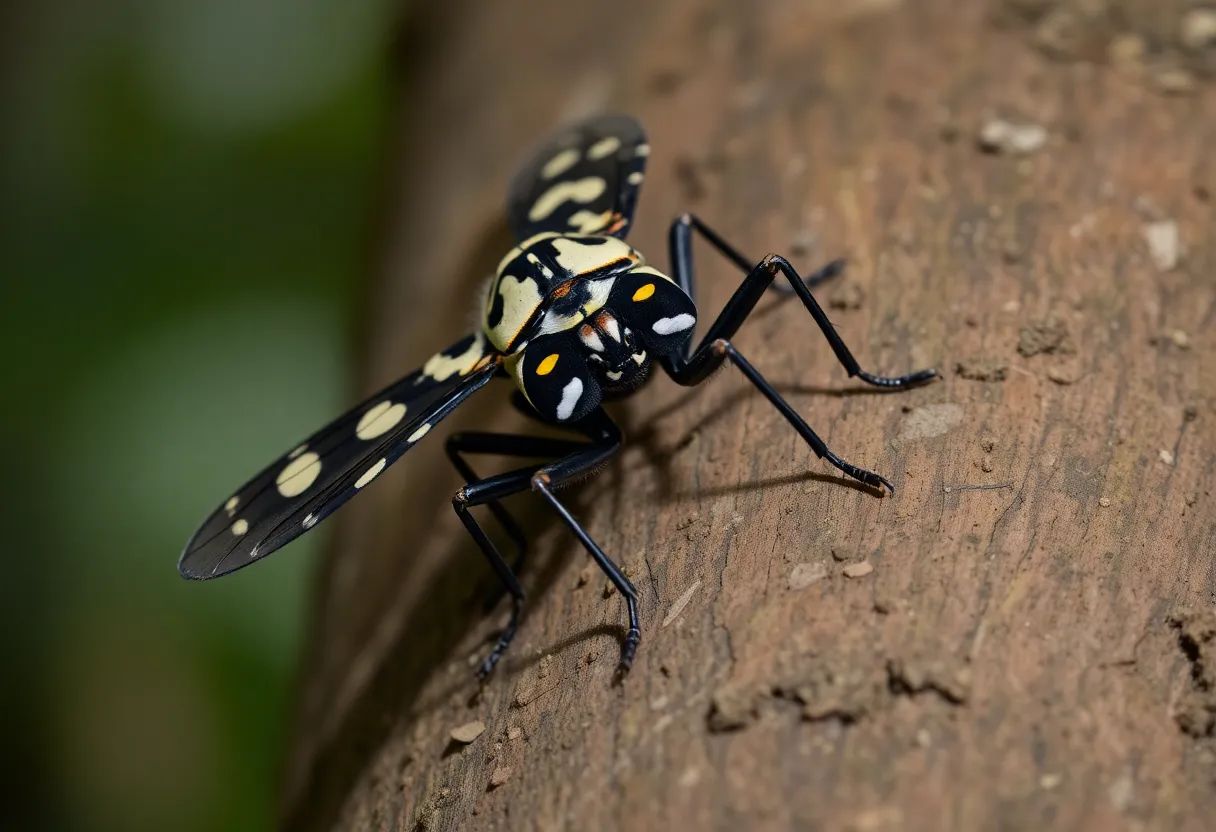
The spotted lanternfly is identifiable by several distinct characteristics. Juvenile forms are initially black and adorned with white spots, transitioning to a bright red color as they mature. Adult lanternflies measure approximately 1 inch long and ½ inch wide, sporting grayish-brown front wings punctuated with black spots, while their striking scarlet back wings display black and white bars.
These insects are most visible during dusk or at night as they migrate along plant trunks. However, during the daytime, they often cluster at the base or canopy of plants, making them more challenging to spot. The insects lay eggs in clusters of 40-50 on nearly any stationary surface such as vehicles, tree trunks, bricks, stones, and other equipment. The eggs are typically described as resembling wet gray putty, which can easily be mistaken for dried mud.
Ecological Impact
One of the most concerning aspects of the spotted lanternfly is its secretion of a sticky substance known as honeydew. This substance not only leads to the development of sooty mold but also fosters an environment conducive to attracting other pests. Additionally, the breakdown of honeydew emits a foul “fermented” odor, compounding the nuisance caused by this pest.
Public Involvement and Response Measures
In light of this discovery, Clemson Extension officials are encouraging the public to assist in monitoring and controlling the pest by reporting any lanternfly sightings through their website. Effective management will also involve collaboration with state, local, and federal agencies, such as the USDA’s Animal and Plant Health Inspection Service (APHIS).
In their efforts to combat the spread of the spotted lanternfly, Clemson officials are actively seeking permissions to access private properties for surveillance and treatment procedures. This proactive approach, coupled with public vigilance, is crucial for preventing the economic and environmental devastation that the spotted lanternfly could bring to South Carolina.
Conclusion
The recent detection of the spotted lanternfly stands as a critical reminder of the importance of invasive species management. Through early detection, public cooperation, and coordinated governmental response, South Carolina aims to safeguard its agricultural integrity against this newly arrived threat.
Deeper Dive: News & Info About This Topic
HERE Resources
Additional Resources
- WLTX
- Wikipedia: Spotted Lanternfly
- Fox Carolina
- Google Search: Spotted Lanternfly South Carolina
- Independent Mail
- Encyclopedia Britannica: Spotted Lanternfly
- WRDW
- Google News: Spotted Lanternfly South Carolina