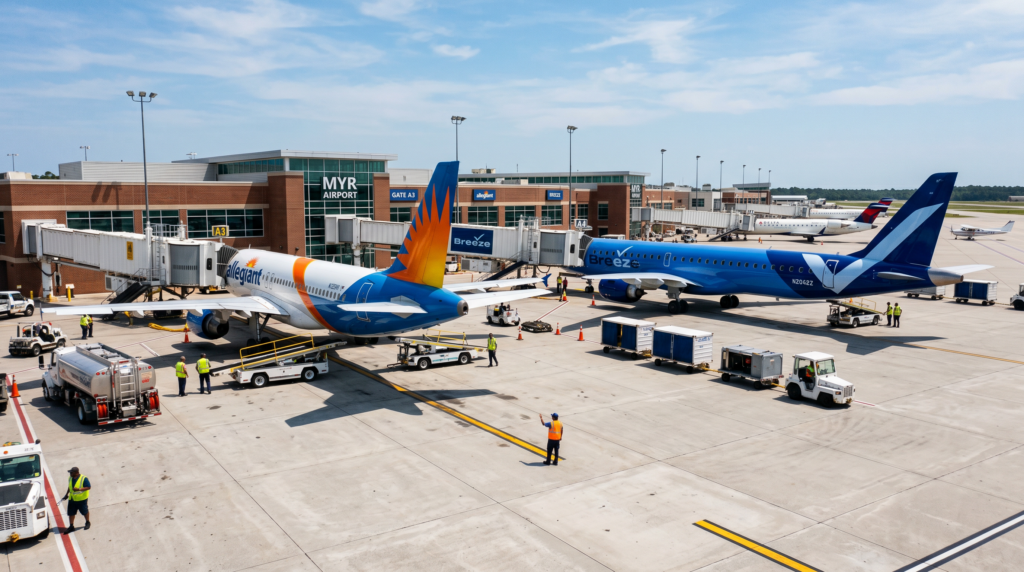
A coalition of low-cost U.S. airlines is pressing the Trump administration for $2.5 billion in emergency fuel relief, warning that jet prices above $4 a gallon could trigger a wave of carrier failures that would reduce competition and raise fares nationwide — including at airports like Greenville-Spartanburg International (GSP) in Greer, which depends on budget carriers for a growing share of its nonstop routes.
The Association of Value Airlines, whose members include Frontier Group and Avelo Airlines, confirmed it has formally requested that the administration create a $2.5 billion liquidity pool dedicated exclusively to offsetting incremental fuel costs. The group calculated that figure by projecting how much more its member carriers expect to spend on jet fuel for the remainder of 2026 compared to earlier forecasts, under the assumption that prices will stay above $4 per gallon through December. The funds, the group said, would be barred from use for recapitalization or any purpose other than fuel receipts.
In exchange, the carriers are proposing that the government receive warrants convertible into equity stakes — a structure drawn directly from the $54 billion in pandemic-era relief provided under the CARES Act, though on a far smaller and more targeted scale. Airline executives met with Transportation Secretary Sean Duffy and FAA Administrator Bryan Bedford on April 21, and administration officials have since elevated the discussions to the White House. No agreement has been reached.
Budget carriers say their situation is categorically different from that of full-service airlines. Carriers such as American, Delta, and United operate on wider margins and can absorb fuel spikes through ancillary fee increases or fare adjustments aimed at higher-income travelers. Low-cost carriers, by design, serve price-sensitive customers who cannot absorb fare hikes, and their thin margins leave almost no cushion. The fuel cost surge, which industry observers trace in part to disruption in global oil markets, has hit the sector at a moment when many of its players were already under financial strain.
Spirit Airlines, which is attempting to complete a Chapter 11 restructuring, is negotiating a separate $500 million government loan that could give the U.S. government a stake of roughly 90 percent in the carrier. The Association of Value Airlines argued in a letter to congressional leaders that temporary relief would “preserve vital industry competition” and keep airfares affordable during what it called a period of acute volatility.
The stakes are concrete for the Upstate South Carolina travel market. GSP, located in Greer along the Spartanburg-Greenville corridor, has built out a meaningful budget-carrier footprint over the past two years. Allegiant Air currently operates multiple nonstop leisure routes from GSP, with fares starting as low as $39 to Florida destinations. Breeze Airways, which entered GSP in May 2024, expanded to ten nonstop routes by early 2026 — including new service to Fort Lauderdale and Cincinnati starting in July 2026. Both carriers fall squarely in the ultra-low-cost and value-carrier category that the fuel relief proposal is designed to protect. A contraction of capacity at either airline could reduce access to nonstop routes that regional passengers rely on and that GSP has invested considerable effort in attracting.
Rep. William Timmons, whose SC-4 district covers both Greenville and Spartanburg counties, sits on the House Financial Services Committee — a panel that would have oversight over any government warrant or equity structure tied to an airline rescue package. Sen. Tim Scott, who serves on the Senate Finance Committee, would be a key figure in any legislative route the aid package might take. Neither office had issued a public statement on the proposal as of Monday.
Whether the administration agrees to act remains uncertain. The proposal has no parallel among current competitors — carriers such as Delta and United have not requested relief and are expected to report solid first-half results. Critics argue that backstopping airlines against input-cost volatility sets a precedent that other fuel-dependent industries will quickly seek to exploit. Supporters counter that the government’s own geopolitical decisions contributed to the fuel-price environment these carriers now face, and that allowing multiple low-cost carriers to collapse would leave millions of travelers with fewer options and higher fares.