After peace talks in Islamabad, Pakistan collapsed over the weekend without a deal, President Donald Trump announced Sunday that the U.S. Navy will begin blocking all Iranian oil shipments through the Strait of Hormuz starting Monday morning. Vice President J.D. Vance, who led the U.S. delegation through 21 hours of negotiations, said the two sides were “too far apart on key issues,” with Iran unwilling to commit to halting its nuclear program. Global oil prices surged immediately following the announcement, with Brent crude trading at $103.72 per barrel as of Monday morning — roughly $39 higher than one year ago.
The blockade represents a significant escalation in the ongoing U.S.-Iran conflict, which has kept oil markets on edge since hostilities began earlier this year. With Iranian ports and coastal areas in both the Arabian Gulf and Gulf of Oman now subject to U.S. naval enforcement, shipping lanes that carry a substantial portion of the world's oil supply face new uncertainty. Analysts note that while most U.S. crude does not flow through the Strait, global oil pricing is interconnected — and the surge to over $100 per barrel is already rippling into consumer prices at the pump.
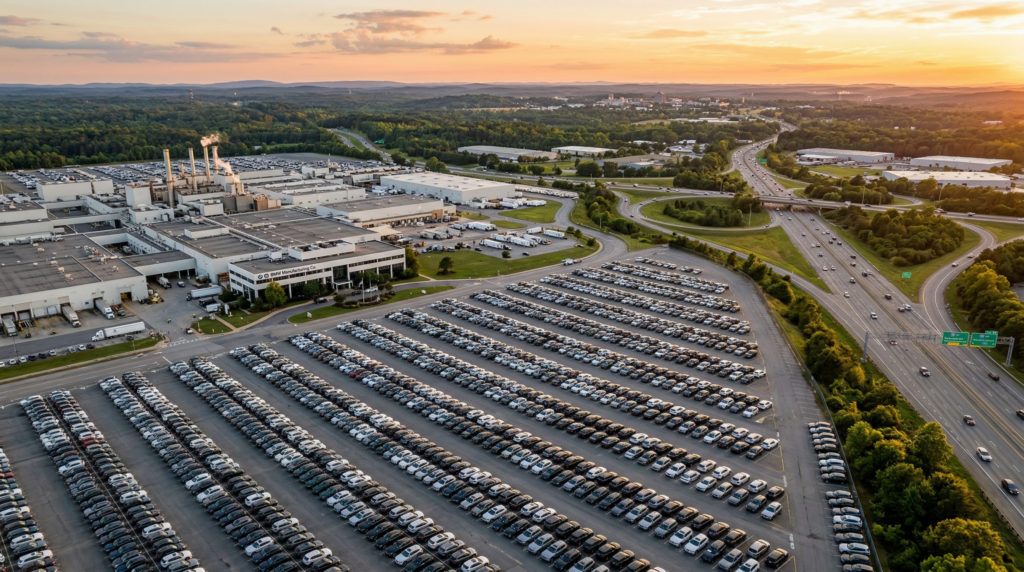
For Spartanburg County, the stakes are concrete. The BMW manufacturing plant in nearby Greer — the largest BMW plant in the world — produces approximately 1,500 vehicles per day and employs more than 11,000 workers across Spartanburg County. The plant is heavily dependent on supply chains that span multiple continents, and BMW has already warned investors of a 1.25 percentage-point blow to its core automotive margin in 2026 due to tariff pressures. Rising fuel costs add another layer of strain: diesel prices in the Spartanburg metro area have climbed to $5.74 per gallon, according to AAA data, up from $3.30 a month ago — a 74% increase. Every inbound truck hauling parts to the Greer plant and every outbound carrier shipping finished vehicles to port in Brunswick, Georgia, burns that diesel.
Beyond BMW, Spartanburg County's broader manufacturing corridor along I-85 and I-26 — home to Michelin North America, Milliken & Company, and hundreds of supplier firms — faces similar pressures. Fuel surcharges are a standard feature of freight contracts, meaning higher diesel costs get passed down the supply chain quickly. The county attracted $3.5 billion in capital investment in 2025 in part because of its reputation as a low-cost, logistics-friendly manufacturing hub. Sustained fuel price increases threaten that calculus.
South Carolina consumers are feeling the squeeze at the pump as well. Regular unleaded in the Spartanburg metro averaged $3.82 per gallon as of Sunday, according to AAA — up from $2.80 a year ago, a roughly 37% increase. Spartanburg County residents who commute along I-85 or I-26 are paying substantially more to reach jobs at the county's industrial parks, distribution centers, and healthcare facilities.
What's Happening
When and where is this happening?
The U.S. Navy blockade of Iranian oil shipments through the Strait of Hormuz began Monday, April 13, 2026 at 10 a.m. Eastern Time. The impact on global oil prices and local fuel costs is already under way.
Who is involved?
President Trump ordered the blockade after peace talks led by Vice President J.D. Vance collapsed in Islamabad over the weekend. The economic impact extends to local employers including BMW's Greer manufacturing plant and the broader Spartanburg County manufacturing corridor.
Why does this matter to Spartanburg?
Spartanburg County is one of the most manufacturing-dense counties in the Southeast, with BMW, Michelin, and hundreds of supplier firms. Rising diesel prices directly increase operating costs for every freight carrier moving goods through the county's industrial parks.
What should residents know?
Regular gasoline in the Spartanburg metro averaged $3.82 per gallon as of Sunday — up roughly $1 from a year ago. Diesel is averaging $5.74 per gallon, near a record high. AAA advises against panic buying, as there is no supply shortage at this time.
What happens next?
The ceasefire between the U.S. and Iran is set to expire April 22. If negotiations do not resume or a new deal is not reached, the blockade is expected to continue, keeping upward pressure on oil and fuel prices through at least late April.