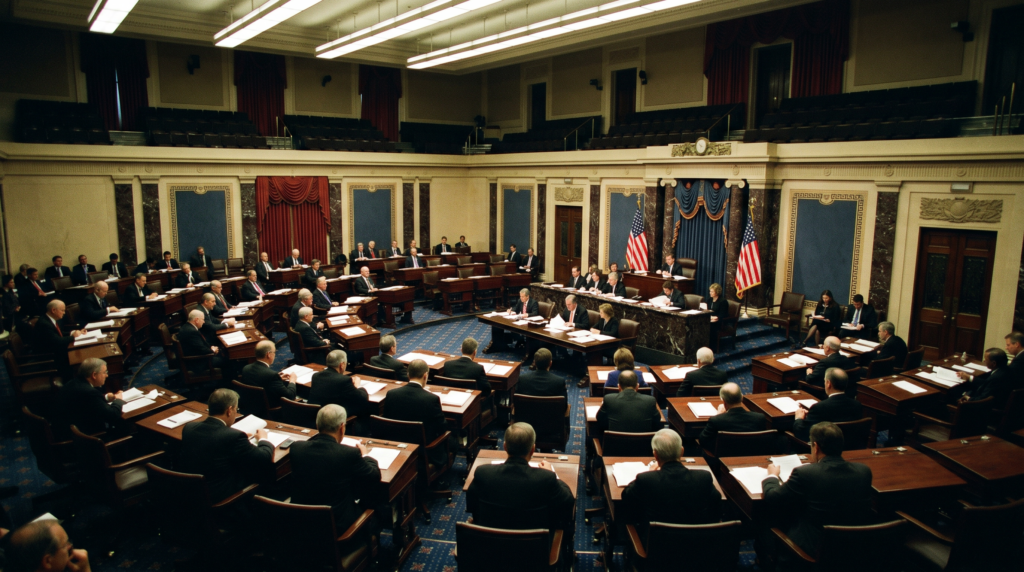
South Carolina’s senior senator moved the Republican-controlled chamber one step closer to funding immigration enforcement agencies without Democratic support, completing an overnight marathon of votes early Thursday morning to advance a budget blueprint that party leaders say is essential to ending a months-long partial shutdown of the Department of Homeland Security.
Senate Budget Committee Chairman Lindsey Graham unveiled budget resolution S.Con.Res.33 on Tuesday, setting the stage for the Senate to begin a process known as budget reconciliation — a parliamentary tool that allows the majority party to advance legislation with direct budgetary consequences using only a simple majority of 51 votes rather than the 60-vote threshold typically required. Graham framed the action in his committee release as urgent and straightforward: fully fund Border Patrol and ICE at a moment he described as a time of serious threat to the United States, noting that Democratic colleagues had been working to block that outcome.
The chamber first approved a motion to proceed on Tuesday by a 52-to-46 party-line vote. Then, after a roughly six-hour overnight session that stretched past 3:30 a.m. Eastern on Thursday, the Senate adopted the resolution itself by 50 to 48. The two departures from the Republican line were Sens. Rand Paul of Kentucky and Lisa Murkowski of Alaska, who sided with Democrats in opposing the measure.
Paul argued in floor debate that appropriating another $70 billion for ICE and Border Patrol was fiscally irresponsible given that those agencies reportedly retained more than $100 billion in unobligated funds carried over from last year’s One Big Beautiful Bill Act. Paul proposed covering any new border security costs through offsets — including cuts to refugee welfare programs, the National Science Foundation, and the Department of Education — and said in a floor statement that Congress must be prudent stewards of taxpayer money while fully accounting for the billions needed to secure the borders.
Murkowski’s objection was structural rather than fiscal. The Alaska senator, a senior member of the Appropriations Committee, opposed routing ICE and Customs and Border Protection funding through reconciliation because doing so would effectively remove those agencies from the regular annual appropriations process — the traditional mechanism through which Congress exercises ongoing oversight. While she has publicly supported funding the agencies, she has raised concerns about sidelining the normal appropriations framework.
The Graham resolution instructs the Senate Judiciary Committee and the Homeland Security and Governmental Affairs Committee to each draft legislation that could increase the federal deficit by up to $70 billion each, which would be used to fund Immigration and Customs Enforcement and parts of Customs and Border Protection. The final bill’s price tag is expected to be around $70 billion total — not $140 billion — with the higher per-committee ceiling designed to give each panel maximum flexibility as they write the underlying bill. Republicans intend for the funding to cover ICE and CBP operations for three-and-a-half years, carrying the agencies through the remainder of President Trump’s current term.
DHS has been operating without its base funding since February 14, the longest partial shutdown in the department’s history. The Senate separately passed a bipartisan bill to fund the non-immigration components of DHS — agencies such as FEMA, the Transportation Security Administration, and the Coast Guard — but the House has not yet taken up that measure. House Republicans, according to statements from leadership, want assurances that ICE and CBP funding is locked in before they advance any partial DHS bill, arguing they cannot allow those agencies to be left out.
Majority Leader John Thune of South Dakota expressed optimism in remarks around 4 a.m. Thursday that the House would adopt the Senate’s budget resolution without changes. Any modifications, he warned, would send the resolution back to the Senate for another round of amendment votes — a scenario Republican leaders are eager to avoid given the June 1 deadline President Trump has set for a final bill to reach his desk. Thune acknowledged that Speaker Mike Johnson had not yet guaranteed the House would pass the resolution unchanged but said both chambers understand where the process is headed.
Johnson said Tuesday that the House would work closely with the Senate in the coming days as the reconciliation process gets underway, emphasizing that sequencing matters. He said Republican leadership cannot allow critical immigration enforcement agencies to become what he called an orphan in the funding process, and that the two-track approach — appropriations for most of DHS, reconciliation for ICE and CBP — was designed to prevent that outcome.
The budget resolution now moves to the House, where it must be adopted before the relevant committees can begin drafting the actual funding legislation. With S.Con.Res.33 clearing the Senate, the chamber has met its first major milestone in a process that Graham initiated and championed as chairman of the Budget Committee. Graham, who also sits on the Senate Appropriations Committee, has been the architect of the Republican strategy to route immigration enforcement funding through reconciliation after months of failed bipartisan negotiations over DHS reforms tied to two deadly shootings by federal agents in Minneapolis in January.