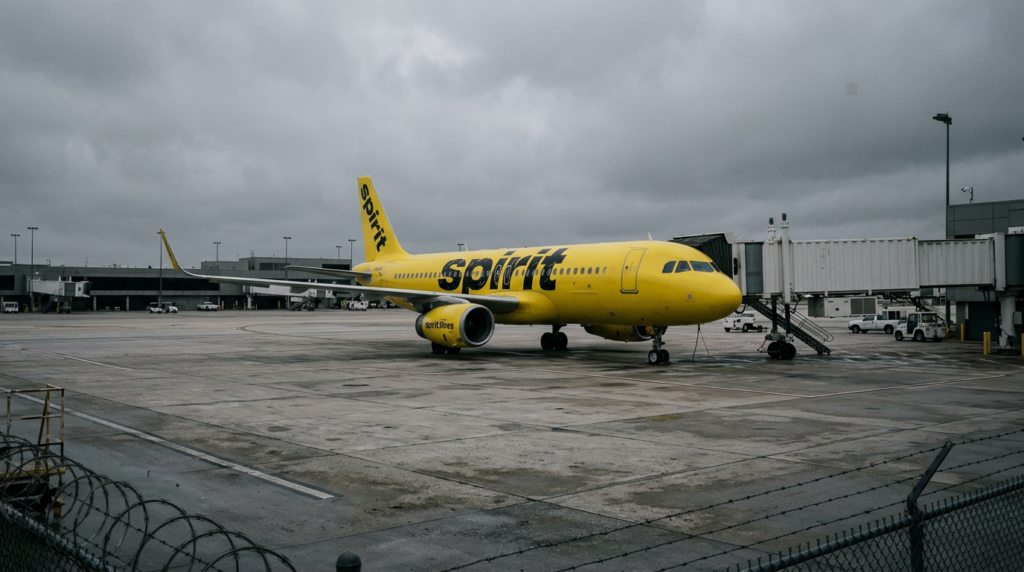
Spirit Airlines ceased all operations on May 2, 2026, announcing an immediate wind-down after last-ditch talks with the Trump administration failed to produce a rescue deal. The carrier’s collapse marks the first major U.S. airline shutdown in more than a decade and the first significant aviation casualty attributed to surging jet fuel costs tied to the ongoing conflict with Iran.
The airline’s parent company, Spirit Aviation Holdings, issued a statement early Saturday declaring that it had begun an orderly wind-down effective immediately and that all flights were canceled. Customers were advised not to travel to airports and were told refunds for credit and debit card purchases would be processed automatically.
A Bailout That Fell Apart
The Trump administration had proposed a $500 million rescue package that would have given the federal government a 90 percent ownership stake in the airline. President Trump described the effort publicly as an attempt to keep low-cost air travel viable for American consumers. However, a group of Spirit’s bondholders — including investment firms Citadel, led by Ken Griffin, and Ares Management Corp. — rejected the terms, concluding the deal left them overexposed if the airline ultimately failed regardless. A counterproposal from creditors was turned down by the government, and talks broke off without resolution late Friday.
Transportation Secretary Sean Duffy characterized the failed negotiation as a creditor problem rather than a government reluctance, and said the administration had made an extraordinary effort. He added that he had approached other airlines about acquiring Spirit but found no interest among potential buyers. With no buyer and no creditor agreement, Spirit’s remaining cash reserves dwindled below operational thresholds.
The White House, for its part, placed blame on the Biden administration, pointing to the 2023 federal court ruling that blocked Spirit’s proposed merger with JetBlue on antitrust grounds. That ruling left the budget carrier without a path to scale, and the Iran-war fuel spike delivered the final blow.
Fuel Economics Behind the Collapse
Spirit’s restructuring plan, filed as it exited its second bankruptcy in recent years, had assumed jet fuel prices of approximately $2.24 per gallon through 2026 and 2027. By late April, prices had climbed to roughly $4.51 per gallon — more than double the planning assumption — as U.S.-Israeli military operations disrupted supply flows through the Strait of Hormuz beginning February 28. The carrier, which had already cut nearly 4,000 jobs and 200 routes during 2025, could not absorb the cost increase without external capital.
A Deutsche Bank analysis estimated that the fuel-price surge would add $24 billion annually to U.S. airline fuel bills industry-wide, with carriers collectively able to recoup only $14 billion through higher fares — leaving an $8.4 billion shortfall. For ultra-low-cost carriers like Spirit, which operate on thin margins and lack the loyalty program revenue that cushions larger airlines, the math was unsurvivable.
Scope of the Shutdown
Spirit had scheduled 4,119 domestic flights offering 809,638 seats between May 1 and May 15, all of which were immediately voided. The airline employed approximately 7,500 workers at the end of 2025, including roughly 2,000 pilots and 3,000 flight attendants. Union leaders representing pilots described the closure as a devastating blow to employees who had made wage concessions during the restructuring process in the belief the company had a viable future.
Major airlines including United, Delta, American, JetBlue, and Southwest agreed to cap fares and offer discounted rescue tickets for affected Spirit passengers in the days following the announcement. United alone rebooked more than 14,000 Spirit travelers within 12 hours of the shutdown. Frontier Airlines announced discounted fares for displaced customers as well.
What It Means for the Upstate
Greenville-Spartanburg International Airport (GSP) never operated direct Spirit service, but the carrier’s collapse narrows the already limited pool of ultra-low-cost options for Upstate travelers. GSP currently serves 31 domestic destinations through seven carriers — American, Delta, United, Southwest, Allegiant, Breeze, and Avelo — but none operates at the price floor Spirit occupied nationally. The shutdown removes one of the budget-carrier options passengers in the Upstate have used for connections through Spirit’s hub airports in Florida and the Caribbean.
The broader fuel-price crisis also carries implications for Spartanburg County’s manufacturing sector. BMW Manufacturing in Spartanburg County — the single largest U.S. exporter of vehicles by value, shipping more than 200,000 vehicles annually — relies on an aviation cargo ecosystem for time-sensitive parts, specialist components, and executive logistics. Fuel costs that break smaller carriers can cascade into higher cargo rates and reduced air-freight capacity, a dynamic BMW and other Upstate manufacturers will be monitoring as the Iran conflict extends into the summer travel season.
South Carolina’s senior senators reflected broader Republican ambivalence about the bailout. Sen. Lindsey Graham, who sits on the Senate Appropriations Committee, and Sen. Tim Scott, a member of the Senate Finance Committee and a prominent economic policy voice, represent a GOP caucus that was deeply divided on whether federal intervention in a private airline’s bankruptcy was appropriate. Multiple Republican lawmakers on Capitol Hill voiced opposition to the deal terms before talks collapsed, citing concerns about the precedent of government equity stakes in distressed commercial companies.