A California man armed with a shotgun, handgun and knives rushed a Secret Service checkpoint outside the White House Correspondents Dinner on the evening of April 25, triggering a frantic evacuation of President Donald Trump, Vice President JD Vance and roughly 2,600 attendees from the Washington Hilton ballroom — and setting off an urgent national debate about whether the event carried enough federal protection given the concentration of senior officials under one roof.
Cole Tomas Allen, 31, of Torrance, California, was taken into custody near the main magnetometer screening area outside the hotel banquet hall at approximately 8:36 p.m. EDT, according to police. Investigators said he had checked into the Washington Hilton as a registered guest before the dinner, a detail that appears to have allowed him to move through earlier layers of the hotel access controls. Once he reached the security checkpoint, Allen charged past the barrier, fired at least one shot and was quickly tackled by agents. One Secret Service officer was struck in a bullet-resistant vest and was expected to recover; no other injuries were reported.
Federal prosecutors identified Allen as facing preliminary charges of using a firearm during a crime of violence and assaulting a federal officer with a dangerous weapon. U.S. Attorney Jeanine Pirro, who was herself inside the ballroom during the shooting, said additional charges were anticipated. The Department of Justice announced the following day that preliminary findings indicated Trump was the intended target.
Writings attributed to Allen described an intention to target officials from the Trump administration; in those writings, Allen referred to himself as the Friendly Federal Assassin. The writings also expressed surprise that he had been able to check into the hotel the day before the event while carrying a shotgun, handgun and knife, packed in luggage. Investigators said Allen traveled by Amtrak from Los Angeles to Chicago and then onward to Washington, D.C.
Acting Attorney General Todd Blanche confirmed the travel route during a Sunday morning interview. FBI agents executed a search warrant at Allen home in the Old Torrance neighborhood of Los Angeles shortly after the incident. Allen sister, reached by agents in Rockville, Maryland, told investigators her brother had a tendency to make radical statements and had spoken of plans to do something to fix the problems he saw in the world.
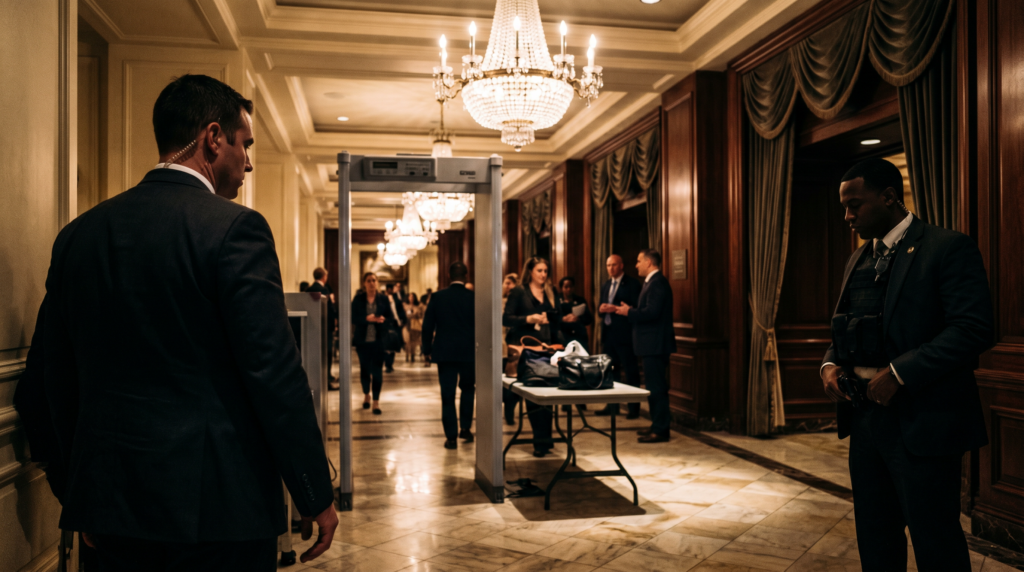
The security architecture at the event has drawn scrutiny in the aftermath. The Washington Hilton lobby remains accessible to hotel guests throughout the dinner, and security screening — including metal detectors staffed by both the Secret Service and the Transportation Security Administration — is positioned closer to the ballroom itself rather than at the hotel outer perimeter. Security footage released after the shooting showed Allen running past personnel who were in the process of removing the magnetometers, a procedure that occurs once the president is seated and no additional guests are permitted into the secured zone.
Secret Service Director Sean Curran defended the response, saying the multi-layered protection functioned as designed and that agents apprehended the suspect before he could reach the ballroom. Interim D.C. Police Chief Jeffery Carroll echoed that the security plan, crafted by the Secret Service, worked as intended. Inside the ballroom, armored plates had been placed beneath the table where Trump was seated, agents were stationed in front of the stage and in the wings, and counter-assault teams were positioned throughout the venue.
The event drew approximately 2,600 attendees including Vice President Vance, FBI Director Kash Patel, Secretary of State Marco Rubio and other senior Cabinet officials. Former FBI Deputy Director Andrew McCabe said beforehand that security at an event with that concentration of senior government officials approached the level of a national security event, given the coordination required between the Secret Service and partner agencies.
Trump was escorted offstage about ten seconds after the shots were fired, briefly falling during the evacuation. First Lady Melania Trump and Vance were moved to secure holding areas within the hotel. Trump departed for the White House at approximately 9:45 p.m. after law enforcement declared the area a crime scene. He later said the dinner would be rescheduled within 30 days and described the venue as not a particularly secure building.
The shooting at the Washington Hilton carries a particular historical resonance: it was at the same hotel entrance that John Hinckley Jr. attempted to assassinate President Ronald Reagan in 1981. Since that attack, the hotel implemented dedicated security infrastructure for presidential visits, including a secured garage linked to a private elevator and presidential suite.
South Carolina Sen. Lindsey Graham, who spoke directly with Trump following the incident, called the Secret Service response heroic and voiced support for constructing a dedicated presidential ballroom at the White House. Graham argued such a facility would give the Secret Service full control over the security environment for large gatherings, and said the most immediate benefit would be allowing the president to attend formal functions without leaving the White House grounds. Graham also described the threats facing the president as unprecedented.
Rep. William Timmons, who represents SC-4 covering Spartanburg and Greenville, sits on the House Oversight Committee — one of the panels positioned to scrutinize federal agency operations including Secret Service security protocols and resource allocation. Allen is scheduled for formal arraignment in federal court, with indictment proceedings expected in the coming weeks.