The Pentagon has told members of Congress that fully clearing the Strait of Hormuz of Iranian naval mines could take as long as six months — a timeline that, if it holds, would keep global oil supplies disrupted and pump prices elevated well into the back half of the year.
The assessment was delivered during a classified briefing to the House Armed Services Committee on Tuesday. A senior defense official told lawmakers that Iran has likely placed 20 or more mines in and around the strait, some of them equipped with GPS technology and deployed remotely from small, fast-moving boats. That combination of remote triggers and GPS-linked positioning makes the devices significantly harder for standard mine-sweeping equipment to detect and neutralize, the official explained.
Pentagon spokesman Sean Parnell pushed back on the characterization after the briefing details became public, saying that a single internal assessment does not constitute official policy and that the Defense Department views a six-month strait closure as an impossibility that is completely unacceptable to Defense Secretary Pete Hegseth. Parnell also criticized the selective disclosure of information from what he described as a closed, classified session.
The conflicting signals — a six-month working estimate shared inside the building, a flat public denial outside it — reflect the political stakes attached to the strait. Roughly one-fifth of the world’s oil and liquefied natural gas passes through the 21-mile-wide chokepoint each day. Any prolonged blockage translates directly into prices at the pump.
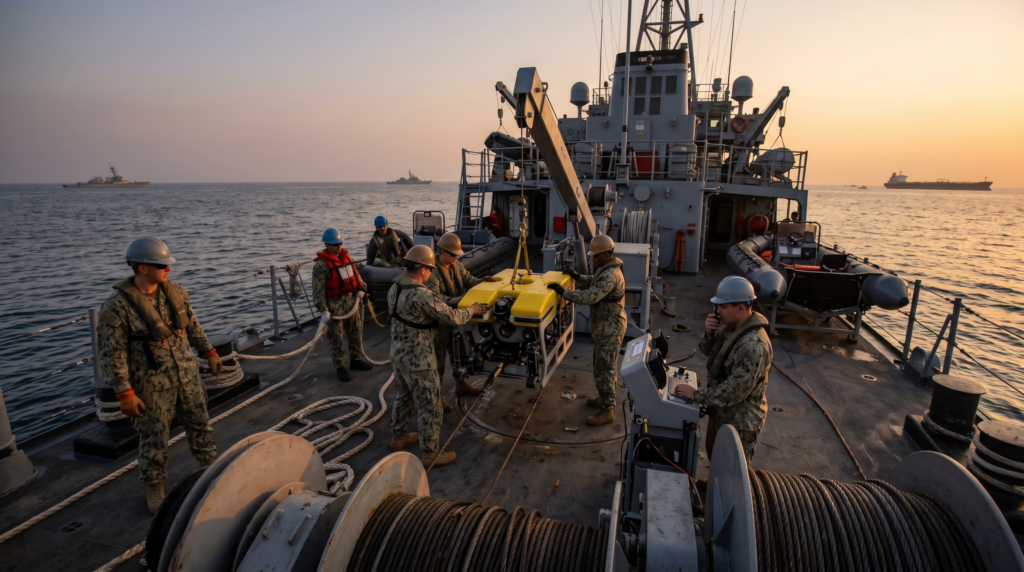
President Trump weighed in Thursday on Truth Social, ordering the U.S. Navy to shoot and kill any vessel observed laying mines in the waterway and directing minesweeping operations to continue at tripled intensity. Trump also said American sweepers were already clearing the strait and asserted that no ship can enter or leave without U.S. Navy approval.
The broader context: a precarious ceasefire between the United States and Iran remains in effect but fragile. Pentagon officials have indicated that full-scale mine-clearing operations are unlikely to begin in earnest before the conflict reaches a definitive diplomatic conclusion, meaning the six-month clock may not even start until hostilities formally end.
According to AAA data updated April 23, South Carolinians are paying an average of $3.66 per gallon for regular unleaded — up from $2.75 a year ago. Spartanburg County sits at $3.65 per gallon, having climbed roughly 33 percent year-over-year. Those figures track closely with the national average of $4.03, which surpassed the $4.00 threshold for the first time since August 2022 in early April, driven largely by the disruption in Hormuz transit.
The intelligence picture and the gas-price math both weigh on South Carolina’s congressional delegation. Sen. Lindsey Graham, the state’s senior senator and a member of both the Senate Armed Services and Appropriations committees, has been among the most visible voices in Washington on U.S.-Iran policy. Rep. William Timmons, who represents the Greenville-Spartanburg district in the SC-4 seat, sits on the House Financial Services and Oversight committees and would be among the members tracking the economic fallout from any prolonged energy disruption. Three other SC House members — Nancy Mace (SC-1), Joe Wilson (SC-2), and Sheri Biggs (SC-3) — all serve on the House Armed Services Committee, making South Carolina’s delegation particularly well-positioned inside the oversight structure handling this briefing.
Italy has confirmed plans to deploy up to four vessels, including two minesweepers, as part of a multinational effort once conditions allow. Britain and France have also committed mine-clearing capabilities to the coalition. How quickly that international force could supplement U.S. efforts in the strait remains an open question as diplomacy and military operations continue in parallel.