While the vegetable garden gets most of the April attention, Spartanburg’s lawns are telling their own story right now — and the choices homeowners make in these few weeks will determine how their turf performs through the summer. Zone 8a in the Upstate supports both cool-season and warm-season grass types, and mid-April is the critical transition period when the approach needs to shift.
The Upstate’s most common lawn grasses are Bermuda and Zoysia — both warm-season grasses that go dormant and brown in winter and are now waking up for the growing season. Fescue lawns, more common in higher elevations and shadier conditions, are transitioning out of their prime growing window as temperatures rise. Understanding which type of grass you have determines everything about what you should be doing right now.
Bermuda and Zoysia Lawns: Time to Act
For the majority of Spartanburg homeowners with Bermuda or Zoysia lawns, mid-April is the ideal time for the season’s first fertilizer application. Wait until the lawn has broken dormancy and shows at least 50 percent green cover before fertilizing — applying nitrogen to a still-dormant lawn primarily feeds weeds. With most Upstate Bermuda lawns now showing strong greenup after the warm April temperatures, the window is here.
Apply a balanced slow-release nitrogen fertilizer at a rate appropriate to your grass type and the square footage of your lawn. The South Carolina Cooperative Extension Service recommends Bermuda lawns in the Piedmont receive approximately 1 pound of actual nitrogen per 1,000 square feet at this first application, with subsequent applications through the summer at approximately six-week intervals during the active growing season.
Pre-emergent herbicide for summer weeds should have been applied in late February or early March — if you missed that window, you may be dealing with summer annual weeds like crabgrass as they emerge over the next few weeks. Post-emergent options for crabgrass are available but work best on young, actively growing plants.
Fescue Lawns: Different Strategy
Tall fescue lawns, which remain green through the winter and represent a meaningful portion of Spartanburg’s shaded and higher-elevation residential turf, are entering their summer stress period. Fescue does not thrive in the Upstate’s peak summer heat and typically goes partially dormant in July and August. The appropriate response is to avoid heavy fertilization now, maintain consistent watering as temperatures rise, and wait for the fall aeration and overseeding window (September-October) as the primary lawn improvement opportunity.
Mowing Best Practices for Spring
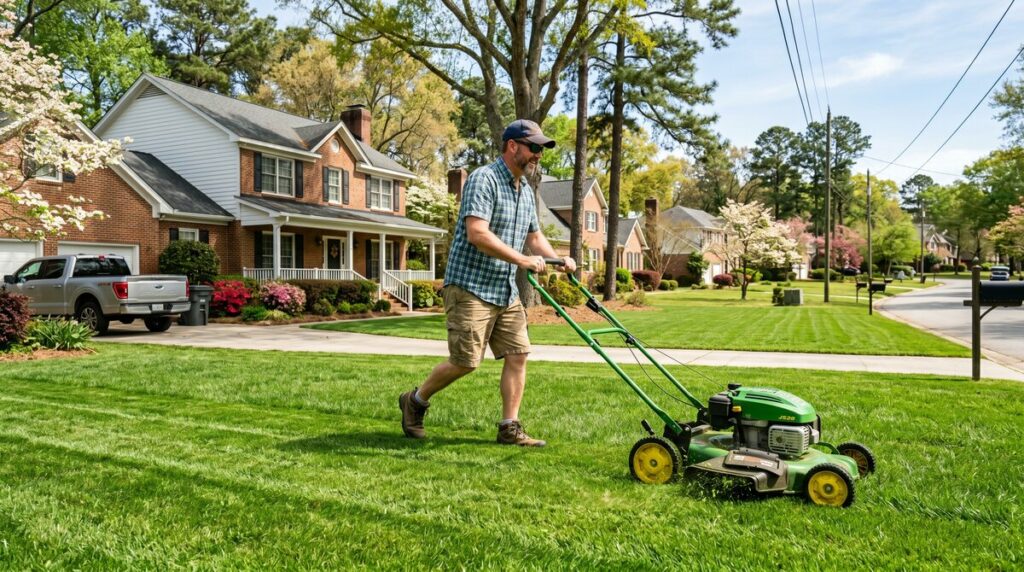
Across all grass types, the spring mowing season calls for a few calibration steps. For Bermuda, raise your mowing height slightly — a height of 1 to 1.5 inches promotes dense horizontal growth and shades out weed competition. For Zoysia, 1.5 to 2 inches is appropriate. For fescue, 3 to 4 inches is the recommended height through the summer, as taller grass shades the soil, reduces moisture evaporation, and improves heat tolerance.
The first scalping mow of the season — cutting Bermuda low to remove winter thatch and encourage horizontal spread — should have happened in late February or early March. If you have a thick thatch layer, core aeration in late April or May will improve water and nutrient penetration and is among the highest-return investments a Bermuda or Zoysia homeowner can make.
What’s Happening: Q&A
Q: When should I fertilize my Bermuda lawn in Spartanburg?
Now — mid-April is ideal, once the lawn shows at least 50 percent green cover confirming it has broken dormancy. Apply a slow-release nitrogen fertilizer at approximately 1 pound of actual nitrogen per 1,000 square feet for the first application.
Q: I missed the pre-emergent window. What do I do about crabgrass?
Post-emergent crabgrass control products are available and work best on young, actively growing plants. Act as soon as you see crabgrass emerging — typically by mid-May in the Upstate.
Q: What is the right mowing height for Bermuda grass?
1 to 1.5 inches promotes dense horizontal growth and helps shade out weed competition. Zoysia does well at 1.5 to 2 inches. Fescue should be kept at 3 to 4 inches through summer.
Q: Should I fertilize my fescue lawn in April?
No. Fescue enters summer stress in the Upstate and does not benefit from heavy spring fertilization. Hold off and focus on the fall aeration and overseeding window in September-October for fescue improvement.
Q: Is aeration worth doing in Spartanburg?
Yes. Core aeration of Bermuda and Zoysia lawns in late April or May is among the highest-return lawn investments available, improving water and nutrient penetration through thatch layers that naturally accumulate in warm-season grasses.