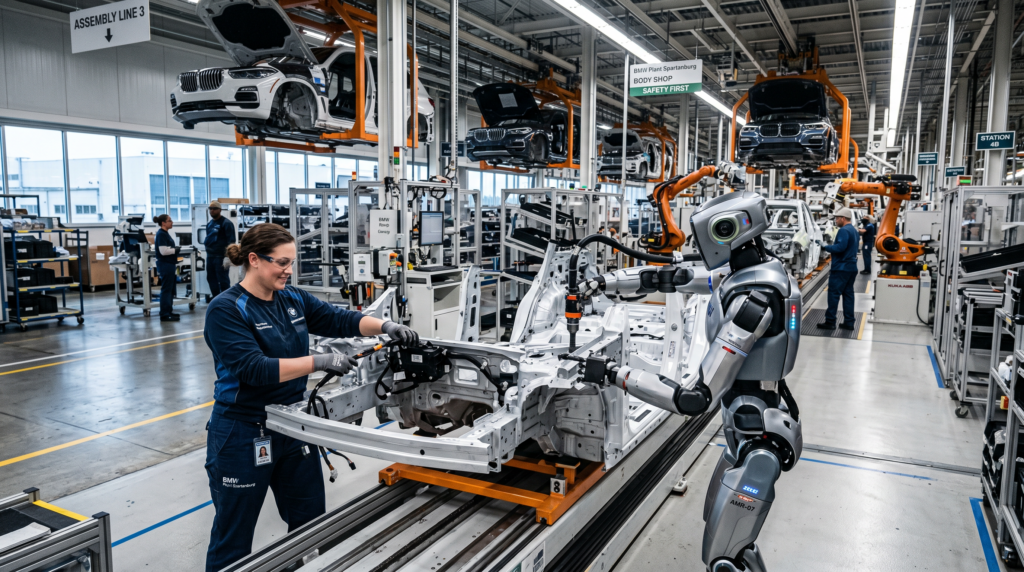
BMW’s Spartanburg plant — the world’s largest BMW facility and the anchor of Upstate South Carolina’s manufacturing economy — is at the center of the automaker’s global push into artificial intelligence and physical robotics. The technology is not hypothetical: the Figure 02 humanoid robot already worked 1,250 hours on the X3 production line in Spartanburg last year, handling precise sheet metal positioning in the body shop and contributing to the production of more than 30,000 vehicles. AI-guided quality inspection systems are also live in the plant. For the 11,000 workers who show up to the Spartanburg campus every day, the question of what this means in practical terms deserves a direct answer.
BMW’s stated approach centers on the concept of “Physical AI” — combining intelligent software agents with robotic systems to handle tasks the company describes as monotonous, ergonomically demanding, or safety-critical. The category is specific: repetitive motions performed thousands of times per shift, awkward body positions required by line geometry, or tasks in areas with elevated safety risk. These are not, in BMW’s framing, the roles requiring the judgment, experience, and adaptability that define skilled manufacturing work. Those human roles — quality oversight, process troubleshooting, robot supervision, maintenance, and integration of new technologies — are explicitly described as the destination for workers as automation expands.
BMW’s press documentation on the Spartanburg pilot notes that early communication with the workforce was a deliberate strategy. The project team communicated the technology’s purpose and workflow from the outset, which resulted in initial curiosity giving way to “natural acceptance” on the shop floor. Workers in Spartanburg’s body shop, which already operates with a high degree of automation and smart transport robots, were described as experienced in integrating new systems — an advantage in the pilot’s success.
For workers concerned about long-term job security, the relevant data point is that BMW is in the midst of a $1.7 billion expansion in Spartanburg and Woodruff to add EV assembly and battery production capacity. A company contracting its workforce does not build out its manufacturing footprint. The expansion is creating new roles, many of which will require exactly the kind of technology integration and advanced manufacturing skills that BMW’s upskilling partnerships with Spartanburg Community College are designed to develop.
The honest answer for BMW Spartanburg workers is that the jobs adjacent to AI and robotics will grow; the purely repetitive jobs will shrink. Getting ahead of that transition — through BMW’s internal training programs, through Spartanburg Community College’s advanced manufacturing certifications, or through the Milliken Innovation Center’s workforce development resources — is the most actionable step available to workers navigating this shift. The technology is here. The preparation window is now.
What’s Happening in Spartanburg
- What AI and robotic systems is BMW bringing to Spartanburg?
BMW is piloting AI-guided inspection systems and physical robots for repetitive assembly tasks, with the goal of improving quality consistency and reducing repetitive-motion injuries. - How will this change day-to-day work for Spartanburg plant employees?
Workers on affected lines will shift toward robot supervision, quality verification, and maintenance roles — tasks that require human judgment and are harder to automate. - What retraining programs does BMW offer?
BMW has partnered with Spartanburg Community College and Tri-County Technical College to offer upskilling programs in robotics maintenance and advanced manufacturing for current employees.