Online marketing advice is almost always written for people with a team and a budget. If you’re a small business owner who is also the marketing department, most of that advice is useless — not because it’s wrong, but because it assumes resources you don’t have. This guide is built around the opposite premise: what’s the minimum set of things that actually drives leads and customers for a 1–20 person business, and what can you safely ignore for now?
The short answer is that four channels drive the overwhelming majority of results for local and regional small businesses. Everything else is optional. Get those four working before you touch anything else.
The four channels that actually matter in year one
1. Google Business Profile
If you do one thing from this guide, do this. Google Business Profile (formerly Google My Business) is the free listing that puts your business on Google Maps and in the local “pack” — the three businesses that appear above the regular search results when someone searches “plumber near me” or “coffee shop downtown.” For a brick-and-mortar or service-area business, this listing is worth more than almost any paid marketing you could do in year one.
Setting it up properly takes about two hours. Here’s the list:
- Claim and verify your listing at business.google.com. Free.
- Fill in every field: business name, address (or service area), phone number, website, hours, holiday hours, categories, services, and attributes (e.g., “wheelchair accessible,” “free Wi-Fi,” “online appointments”).
- Upload at least 10 photos — exterior, interior, team members, your product or work samples, and an owner photo. Real photos, not stock images. Phone photos are fine.
- Create a Google Post once a week. It takes two minutes. An offer, an announcement, a recent project, a seasonal reminder. This signals to Google that the listing is active and managed.
- Reply to every review, positive or negative. Keep replies short, professional, and never defensive. Thank the good ones. Acknowledge and offer to resolve the bad ones.
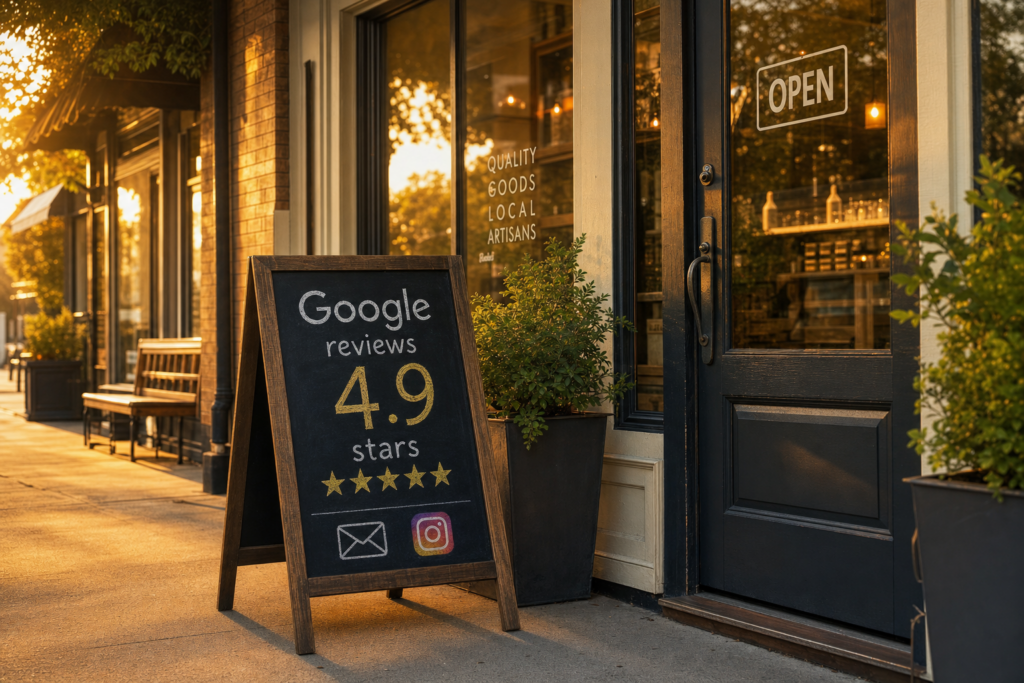
Google reviews are the single biggest trust signal for a local business. Twenty authentic, recent reviews will outperform a $2,000 advertising campaign for most service businesses. Ask every satisfied customer to leave one. Make it easy — text them the direct link.
2. Your website
You need a website. It does not need to be beautiful. It needs to do four things:
- Tell visitors what you do, who you serve, and where you operate in the first sentence of the homepage. Not your founding story. Not your values. What you sell, who buys it, and where you are.
- Have one clear call to action on every page — call, book, request a quote, visit. Pick one action per page. Multiple competing buttons reduce conversions.
- Load fast on a phone. More than half your visitors are on mobile. Test your site at pagespeed.web.dev — a score above 70 on mobile is acceptable; above 85 is good. Anything under 50 is hurting you.
- Display your phone number, email, and address on every page — in the header or footer, not buried on a contact page.
WordPress, Squarespace, Wix, and Shopify all produce perfectly functional small-business sites. The platform doesn’t matter much. Slow load times and copy that talks about yourself instead of your customer are what hurt you. See the common-mistakes section below.
Also: your domain must be HTTPS (the padlock icon in the browser). If it still shows HTTP, fix that with your hosting provider this week. Google deprioritizes insecure sites, and customers notice.
3. Email — still the highest-ROI channel
Email gets dismissed as old-fashioned. The data doesn’t support that view. Email consistently delivers a higher return on investment than any other digital marketing channel for small businesses — typically cited around $36–$42 for every $1 spent in industry benchmarks. That’s not because email is magic; it’s because people who give you their email address have explicitly said they want to hear from you, which makes them far more valuable than anonymous ad viewers.
How to do it right:
- Use a real email marketing tool — Mailchimp, MailerLite, Brevo, Constant Contact, or ConvertKit. All have free tiers that handle up to 500–1,000 contacts.
- Collect emails everywhere: a sign-up form on your website, at checkout, at the front desk, at events. Ask, and most people who like you will say yes.
- Send at least once a month. Twice a month is better. The list goes cold if you go quiet for 60 days — people forget who you are and unsubscribes spike when you return.
- Make emails useful first, promotional second. A ratio of roughly 3:1 (useful content to offers) keeps your list healthy and your open rates high. Open rates above 30% for a small local list are normal and achievable.
- Keep subject lines under 8 words. Curiosity beats cleverness. “3 things to know before hiring a contractor” outperforms “Our Newsletter — July 2025” every time.
A healthy email list of 400–600 engaged local contacts will drive more revenue than most paid advertising budgets for a small business. Build it steadily from day one.
4. One social channel — done consistently
The biggest social media mistake small business owners make is spreading thin across four platforms and doing none of them well. Pick one. The right one is the one where your actual customers spend time:
- Facebook — service businesses, contractors, home services, restaurants, anything that targets adults 35 and older. Community groups are particularly effective for awareness in smaller markets.
- Instagram — anything visual: food, retail, design, fitness, beauty, events, real estate, home improvement. If your work is photogenic, this is worth serious effort.
- LinkedIn — B2B businesses, professional services (accounting, legal, consulting, insurance, staffing), commercial real estate, anyone whose customer is a business rather than a consumer.
- YouTube — any business where demonstrating process builds trust: contractors, mechanics, instructors, anyone with a “before and after.” Videos compound over time in search; it’s the slowest channel to build but one of the most durable.
- TikTok — works if your customers are under 40 and you’re comfortable on camera. High reach, difficult to convert to local customers at small scale.
Whatever channel you pick: two quality posts a week is the minimum. Show your real work. Show the people behind the business. Show the specific communities and neighborhoods you serve. Generic stock-photo content gets ignored. Real, specific, local content gets shared.
What to skip in year one
These are real marketing tactics. They are not where a small business with limited time and budget should start:
- Google Ads and Meta (Facebook/Instagram) paid advertising. Don’t pay for traffic until your website converts the free traffic you’re already getting. Most owners who run paid ads too early spend $2,000–$5,000 learning that their landing page or offer wasn’t ready. Fix the organic foundation first.
- A second social channel. Once your first channel is producing consistent engagement — meaning you post every week, respond to comments, and can see people coming from it — then add a second. Not before.
- A monthly SEO retainer. A well-maintained Google Business Profile, a fast site with clear local copy, and consistent Google Posts will deliver most of the local SEO benefit a new small business needs. A $1,500/month retainer makes sense once you’ve maximized those free channels.
- Influencer or affiliate programs. Occasionally useful. Rarely the right use of a small budget in year one.
- A podcast or YouTube channel built from scratch. These take 6–18 months to build an audience. They can be excellent long-term plays. They are not year-one basics.
The most common mistakes
Writing about yourself instead of your customer
The single most pervasive small-business marketing mistake: homepage copy that says “We have 25 years of experience,” “We’re family-owned and operated,” “We pride ourselves on excellent customer service.” Nobody reads this. It sounds like every other business in your category.
Replace every sentence like that with something specific about the customer’s outcome. “Same-day quotes.” “We answer the phone.” “Jobs finished on schedule or we discount the invoice.” Specifics convert. Generalities don’t.
No email capture anywhere on the website
If your website has no form, no sign-up offer, and no reason for visitors to leave their email, you’re losing the most valuable thing a visitor can give you. Add a simple offer — a checklist, a discount, “get our monthly maintenance tips” — and a short form on your homepage. Even capturing 10 emails a month compounds quickly.
No analytics installed
You cannot improve what you don’t measure. Install Google Analytics 4 on your website — it’s free, it takes 30 minutes, and it tells you how many people visit, where they come from, and which pages they look at. If you use Google Business Profile, you also get free reporting on how many people call you, ask for directions, or visit your site directly from the listing. Use both.
Asking for reviews but not making it easy
Asking verbally at the end of a job is good. Texting the customer a direct link to your Google review page within an hour of completion is much better. Most email marketing tools and CRM systems can automate this. The businesses with 80+ Google reviews aren’t doing anything special — they’ve just made the ask automatic.
Posting without a goal
Every piece of content should do one of three things: build trust, drive a specific action, or answer a question your customer has. “Happy Monday!” does none of those things. Before you post anything, ask: what do I want the person who reads this to do or believe?
The only three numbers you need to track
Don’t let dashboards become a distraction. Track these three numbers monthly and make decisions based on them:
- Leads per month — phone calls, form submissions, direct messages from people who could become customers. This is your top-of-funnel number. If it’s flat or declining for 90 days, your visibility is the problem.
- New customers per month — actual paying customers acquired. Divide this by leads to get your conversion rate. If leads are healthy but conversions are low, your sales process or offer is the problem, not your marketing.
- Customer acquisition cost (CAC) — total marketing spend divided by new customers. For a business spending $500/month on marketing and acquiring 5 customers, CAC is $100. If your average customer is worth $800 to you, that’s a great number. If they’re worth $90, you have a problem. Track this quarterly.
If all three are growing over a 6-month window, the marketing is working. If one is flat, you know exactly where to look.
A realistic first-year budget allocation
For a total first-year marketing spend of around $1,000:
- $0 — Google Business Profile, organic social posting, review requests. These cost time, not money, and they’re often worth more than paid tactics.
- $300–$500 — Professional photography of your space, team, and product or work samples. The single best marketing investment in year one. Phone photos are adequate for social; professional photos for your website and Google listing will be used for years.
- $0–$150 — Email marketing tool (free tiers handle most small lists; paid tiers start at $15–$20/month).
- $200–$400 — Optionally: one targeted Google Ads or Facebook Ads test campaign once your website is ready. Set a fixed budget, run it for 30 days, measure cost per lead. If the math works, scale it. If it doesn’t, you’ve bought information cheaply.
The owners who overspend on marketing in year one are usually trying to buy their way past doing the unglamorous fundamentals: a clear website, consistent posts, a working email list, and a steady stream of review requests. The fundamentals are free. Do those first.
The honest routine
Online marketing for a small business is not a secret. It’s a weekly routine. Claim the Google listing. Build the simple, fast website. Send the monthly email. Post twice a week on the one social channel. Ask every happy customer for a review. Reply to everything within 24 hours. Install analytics and look at the three numbers once a month.
Do that for 12 consecutive months. You will be among the best-marketed businesses in your category in your market. The reason most businesses aren’t isn’t that the strategy is complicated. It’s that the routine is repetitive — and repetition is what most people stop doing after the first few weeks.