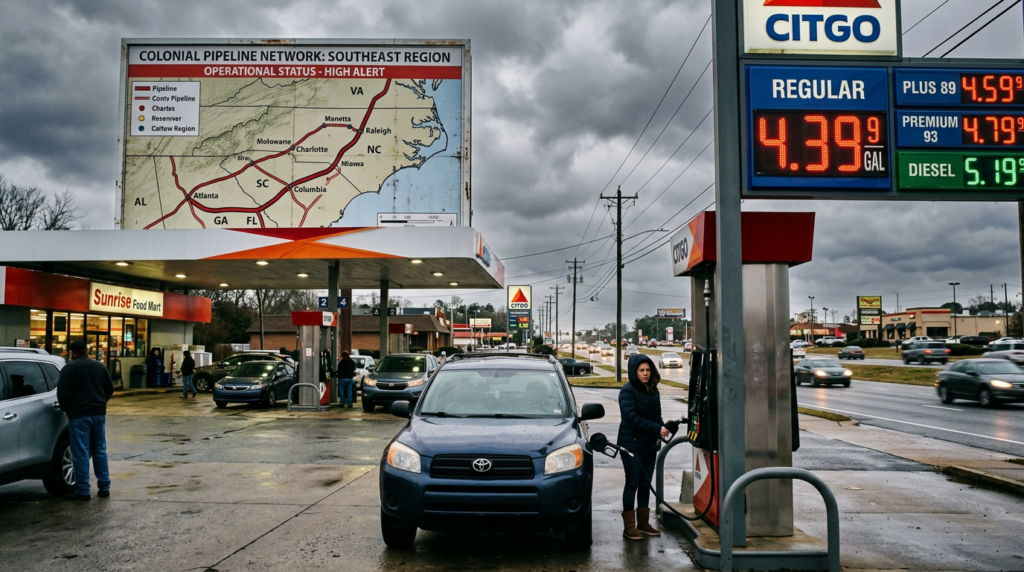
The national average price for a gallon of regular gasoline climbed to $4.39 on May 1 — nearly 33 cents higher than the week before and more than $1.20 above this time last year. The jump marks the sharpest single-week increase since 2022 and reflects two overlapping shocks.
The BP Whiting refinery in northwestern Indiana, a 404,000-barrel-per-day facility, went offline over the final weekend of April after a power outage. The plant came back up quickly, but the disruption pulled refined fuel from Midwest distribution when national gasoline supply was already declining — from 228.4 million barrels to 222.3 million barrels in one week. Illinois, sitting in Whiting’s primary distribution zone, reached $4.66 per gallon by May 1.
The heavier driver is global. The conflict involving Iran entered its 60th day around May 1, with the Strait of Hormuz — through which roughly 20 percent of world oil trade passes — still largely closed to commercial traffic. West Texas Intermediate crude settled near $106.88 a barrel after a seven-dollar single-session gain. The International Energy Agency described the disruption as the largest oil supply shock in the history of the global market.
South Carolina tracked the national move while staying below it. The statewide regular average reached $3.959 on May 1, up 26 cents from $3.697 one week earlier, in motor-club pricing data published this week. In Spartanburg, the average stood at $3.944 — the same weekly gain — while diesel averaged $5.332. A year ago, Spartanburg-area regular sold for $2.809.
The state draws refined fuel primarily through Colonial Pipeline, a 5,500-mile network moving more than 100 million gallons daily from Gulf Coast refineries, supplemented by Plantation Pipeline at roughly 700,000 barrels per day. Both run near capacity under normal conditions, leaving little buffer when crude costs surge.
The diesel cost matters particularly for Spartanburg’s freight network. The SC Ports Authority’s Inland Port Greer — two miles from BMW Manufacturing’s plant in Spartanburg County — uses roughly 22,000 gallons of diesel per month in facility operations, per a recent SC Ports Authority procurement filing. Truck links between the inland port and BMW’s assembly line, which operates on no more than 1.5 hours of parts inventory, now carry fuel surcharges that logistics carriers began applying earlier this year. BMW Manufacturing exported $10.1 billion in vehicles from Spartanburg in 2024, the top value of any U.S. automotive plant, and elevated diesel costs ripple through the more than 40 tier-one suppliers concentrated within a 50-mile radius of the factory.