President Trump announced Friday he will raise tariffs on cars and trucks imported from the European Union to 25 percent, citing the EU’s failure to follow through on a trade framework the two sides agreed to last year. The increase takes effect next week, marking a sharp escalation from the 15 percent rate in place under the deal.
In a social media post, Trump accused the EU of not complying with its commitments and added that automakers producing vehicles inside the United States would face no tariff at all. Speaking to reporters later Friday, he said the Europeans had failed to adhere to last year’s agreement.
The framework at issue — reached at Trump’s Turnberry golf resort in Scotland in July 2025 — set a tariff ceiling of 15 percent on most EU goods, down from the 30 percent level Trump had previously threatened. Europe committed to increasing U.S. investment and easing barriers on American exports; the EU expected the deal to save European automakers roughly 500 million to 600 million euros a month. The new 25 percent rate will be imposed under Section 232 of the Trade Expansion Act of 1962, which authorizes tariffs on national security grounds and was not affected by a Supreme Court ruling this year that invalidated Trump’s other tariff authority. The European Commission said it remains committed to the deal and will keep options open to protect EU interests.
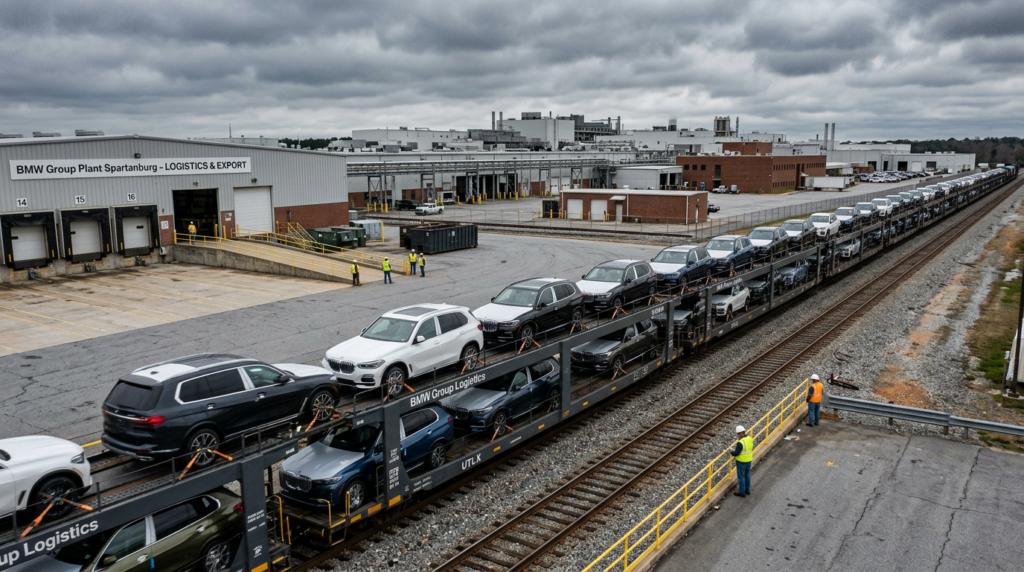
The announcement carries an unusual consequence for Spartanburg County. BMW Manufacturing’s plant in Greer is the largest U.S. automotive exporter by value — for the 12th consecutive year in 2025, the plant shipped nearly 200,000 X-series SUVs to roughly 120 countries with an export value of about $9 billion, according to U.S. Department of Commerce data. The facility employs more than 12,000 people and builds the X3, X5, X6, X7, and XM. About half of all vehicles assembled there are exported, moving by rail through the SC Ports Inland Port Greer — which logged a record 205,523 rail moves in fiscal year 2025 — before connecting to the Port of Charleston overnight on the Norfolk Southern rail line that runs along the I-85 corridor.
Because Plant Spartanburg manufactures inside the United States, its vehicles are exempt from the new EU import tariff. The risk runs the other way: if the EU retaliates against American vehicle exports, the X-series SUVs heading to European buyers could face higher duties abroad. BMW also imports certain models assembled at German facilities, and those vehicles — along with cars from other European-origin brands — would face the 25 percent rate, adding cost pressure across U.S. dealer networks. Analysts say the added uncertainty is complicating automaker investment decisions ahead of a scheduled review of the U.S.-Mexico-Canada trade agreement later this year.