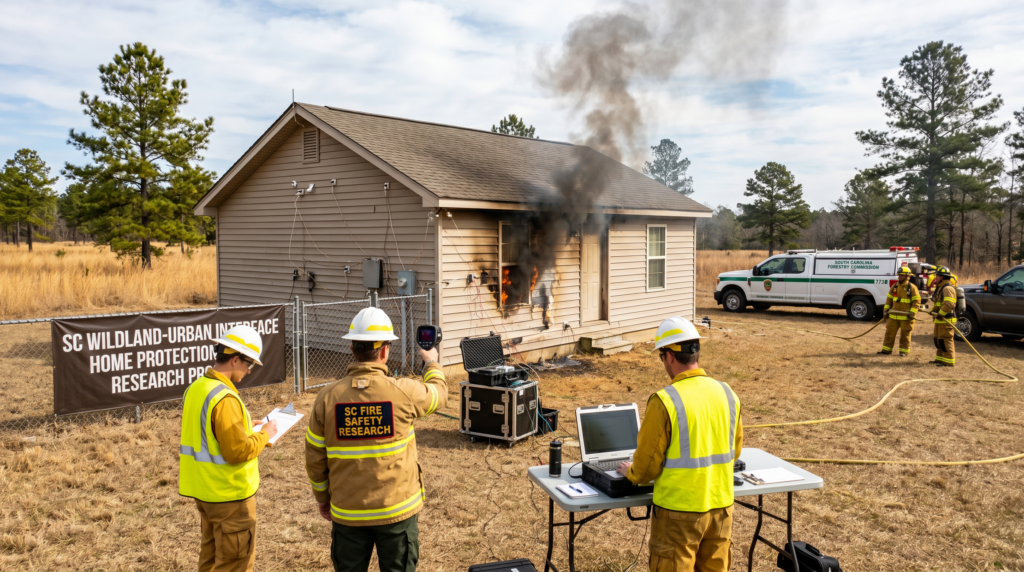
On a 100-acre research campus in Richburg, South Carolina — roughly halfway between Charlotte and Columbia — a nonprofit funded by the insurance industry has been deliberately burning houses. The work is methodical and revealing: researchers at the Insurance Institute for Business & Home Safety (IBHS) have set fire to 13 test structures to date, using a six-story bank of 105 industrial fans to simulate the wind-driven conditions of a wildland fire advancing on a neighborhood.
The results are visceral. In one test, it took less than three minutes for wind-whipped flames to go from licking the side of a test house to shattering a window and burning the entire interior. A second house built in the same spot, fortified with fire-resistant materials, burned dramatically slower. The difference wasn’t luck — it was specific material choices, ventilation design, and a cleared buffer zone around the structure. We crash test houses,
said Roy Wright, IBHS president.
The research is already driving real policy change. California has updated its fire code based on IBHS findings, requiring ignition-resistant walls, tempered or double-paned windows, and mesh over vents to prevent fire embers from entering homes. The institute is now working to translate those lessons to other high-risk areas, including the Carolinas, where recent wildfire seasons in the mountains — including fires that reached North and South Carolina — have demonstrated that wildland-urban interface risk is not limited to the western United States.
For Spartanburg County homeowners, the findings carry practical weight. The research consistently identifies two primary vulnerabilities: embers entering through attic vents and garages, and combustible materials in the 5-foot zone immediately surrounding a home. Wooden fences, pine straw mulch, overhanging branches, and hot tubs with flammable insulation all dramatically increase risk when placed in contact with or adjacent to a structure. Creating a non-combustible buffer zone is one of the most cost-effective fire mitigation steps available to homeowners in any fire-adjacent region.
The institute prefers spring testing at its Richburg site because summer humidity in the Southeast is a poor approximation of western fire conditions. As the 2026 fire season approaches with record-low early-year moisture levels across much of the U.S., the urgency of this research has never been more obvious. Spartanburg homeowners can explore the IBHS’s findings and practical hardening guides at ibhs.org, including their “Fortified” construction standards for new homes and retrofits in fire-risk areas.
What’s Happening in Spartanburg
- Why are SC scientists burning homes?
Researchers at Clemson and partner institutions conduct controlled burns of test structures to study how fires spread, which building materials resist flame best, and how code changes could save lives. - What have they learned so far about home fire safety?
Early findings indicate that attic ventilation design and exterior cladding material are the two largest factors in whether a home survives a wildland interface fire. - How will this research affect SC building codes?
Researchers are working with the SC Building Codes Council; new fire-resistance requirements for new construction in high-risk zones could be proposed as early as next year.