Nearly 1,000 measles cases. The majority in a single county. More than 95 percent concentrated in Spartanburg — the community that hosts BMW’s largest global plant, Spartanburg Regional Healthcare System, and eight separate school districts. The numbers from South Carolina’s 2025-26 measles outbreak are not just a public health statistic. They are a reckoning with what happens when vaccine rates erode quietly, exemption forms multiply, and herd immunity is treated as someone else’s responsibility.
According to data from the Center for Infectious Disease Research and Policy, South Carolina’s Upstate outbreak reached 997 confirmed cases before going a full week without a new infection — a milestone that health officials called cautiously optimistic but not yet a declaration of the outbreak’s end. Of those cases, 940 were in Spartanburg County. School-age children between 5 and 17 made up 456 of the infections. Exposure sites included churches, a Costco, and a community college in Spartanburg.
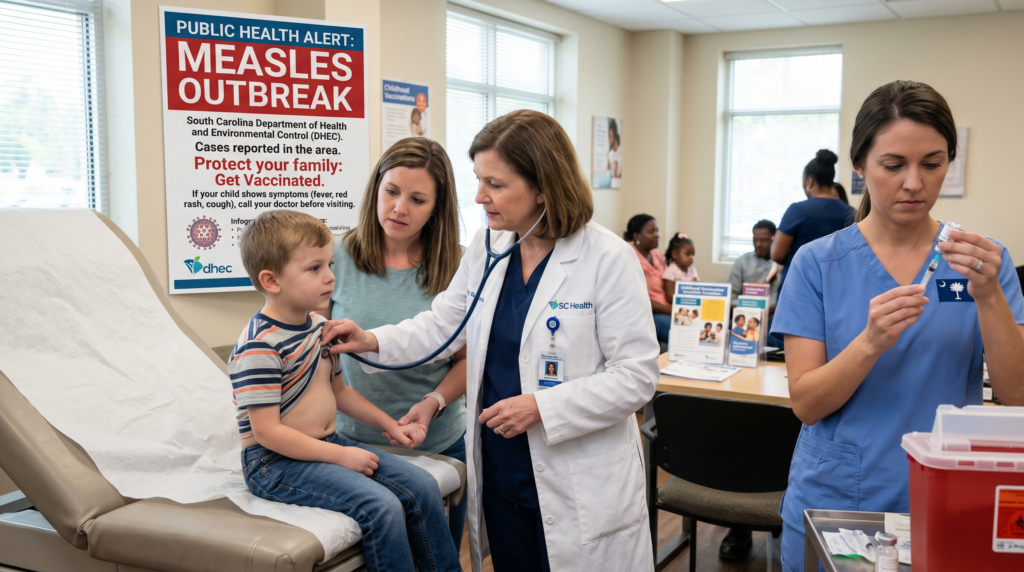
The outbreak exposed what epidemiologists have been warning about for years in South Carolina: pockets of under-vaccination, driven in significant part by increasing use of religious and medical exemption forms, have dropped local MMR coverage below the 95 percent herd immunity threshold in certain school districts and communities. The SC Department of Public Health activated mobile MMR vaccination units throughout the crisis, including free clinics at Zion Hill Baptist Church in Inman and Grace Community Church in Spartanburg.
South Carolina’s MMR vaccination rates have declined modestly over the past decade and now trail neighboring Georgia and North Carolina — states that have taken more aggressive steps to limit non-medical exemptions. State legislators are weighing bills that would tighten exemption standards, with hearings expected in the coming weeks. The debate touches on parental rights, public health authority, and the practical mechanics of school enrollment — all of which play out at the Spartanburg County school district level every fall.
The lesson of the Spartanburg measles outbreak is direct: vaccination rates are a community infrastructure issue, not a personal preference. When coverage drops below thresholds, measles — one of the most contagious diseases known to medicine — finds the unprotected. Spartanburg families who want to verify their children’s MMR coverage can contact their pediatrician, Spartanburg Regional Healthcare System, or the SCDHEC immunization hotline. Prevention now costs a doctor’s visit. The alternative, as this year demonstrated, costs far more.
What’s Happening in Spartanburg
- What did the Upstate measles outbreak reveal about SC vaccination rates?
The outbreak exposed pockets of under-vaccination in several SC counties, particularly among school-age children whose parents have used religious or medical exemptions. - How does SC’s vaccination rate compare to neighboring states?
South Carolina’s MMR vaccination rate has declined slightly over the past decade, now trailing Georgia and North Carolina, raising public health officials’ concerns about herd immunity thresholds. - What actions is the SC legislature considering?
Several lawmakers have introduced bills to tighten exemption standards; advocates on both sides are preparing for hearings in the coming weeks.