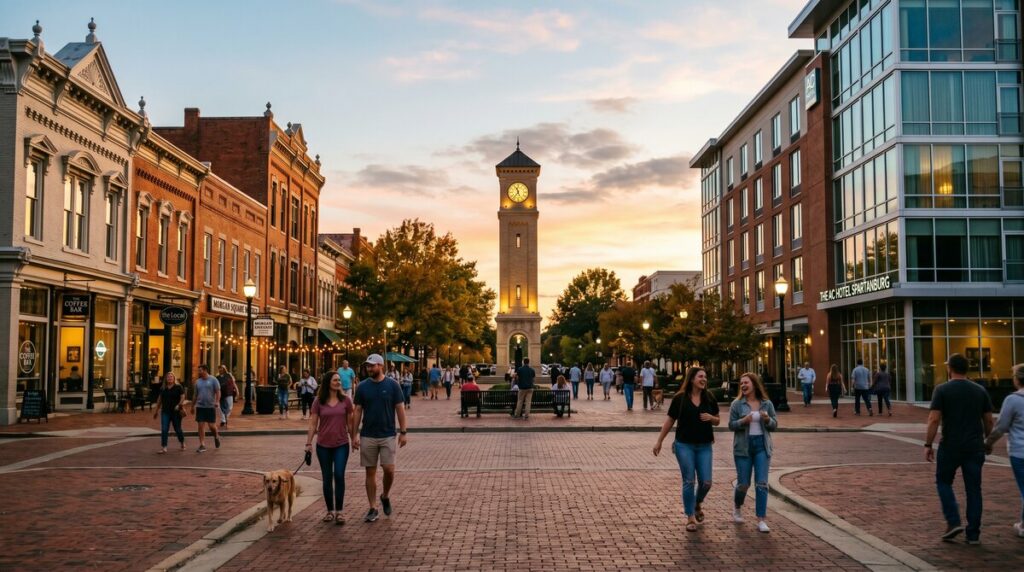
The cranes rising above Beaumont Mill and the new government complex under construction on the city’s southern edge are not the first time Spartanburg has rebuilt itself. The Hub City has reinvented its physical and economic identity before — most dramatically in the post-textile era of the late 1980s and 1990s — and the thread connecting those earlier transformations to the present development boom is longer and more intentional than a casual glance at construction fencing might suggest.
Understanding today’s Spartanburg requires the longer view.
Yesterday: The Textile Capital That Rebuilt Itself
Through much of the 20th century, Spartanburg’s economy and built environment were organized around textile manufacturing. The mills — Beaumont, Glendale, Saxon, Arkwright, Whitney, Clifton — were not just economic engines. They were the physical and social organizing structures of entire communities. Mill villages built around each factory provided housing, churches, schools, and community identity for workers and their families across what is now Spartanburg County.
The textile industry’s collapse in the 1970s and 1980s left those communities hollowed out and left downtown Spartanburg in the condition familiar to many mid-sized Southern cities: vacant storefronts, departing anchors, a civic identity in search of a new chapter.
What distinguished Spartanburg’s response was the deliberate civic strategy that emerged. The arrival of BMW in the early 1990s — secured through an aggressive public-private recruitment effort that is still studied in economic development circles — signaled a pivot from domestic textile to international advanced manufacturing. Michelin had already established its North American headquarters in the Upstate. The region became, improbably, one of the most globally connected manufacturing clusters in the American South.
Today: The Construction Boom and Its Roots
The $300-plus million in current downtown construction — the joint government complex, Beaumont Mill’s 275-unit redevelopment, 111 Main Street, Carolina Foothills FCU’s headquarters, the Daniel Morgan Trail expansion — reflects a Spartanburg that has built genuine economic momentum over three decades.
The mills that once defined the city are being reimagined rather than demolished. Beaumont Mill’s adaptive reuse is a direct line between the city’s manufacturing heritage and its current residential demand — same brick walls, radically different purpose. The impulse to preserve and repurpose rather than bulldoze reflects a civic maturity about Spartanburg’s identity that was not always present in earlier decades.
The downtown core that went quiet after the textile era has been coming back since the mid-2000s, accelerating through the 2010s as the Hub City Bookstore, the Chapman Cultural Center, the Marriott and AC Hotel development, and dozens of restaurants and shops filled blocks that once sat empty. The clock tower debate playing out at City Council — whether to restore, relocate, or replace the Morgan Square landmark — is itself a sign of a downtown important enough to argue about.
Tomorrow: What the Vision Points Toward
The projects currently under construction are not random. They represent outcomes of deliberate decisions made in OneSpartanburg Vision Plan processes, county and city comprehensive plans, and private investment frameworks built on confidence in the Upstate’s fundamentals.
Tomorrow’s Spartanburg — the city that emerges from the current construction cycle — will have a joint government complex that consolidates civic services, a revitalized Beaumont neighborhood adding hundreds of residents to walkable proximity of downtown, an expanded trail network linking neighborhoods to each other and to the urban core, and a small business ecosystem equipped, hopefully, to compete in an AI-accelerated economy.
The same qualities that let Spartanburg survive the textile collapse and attract BMW — civic leadership willing to invest in the future, a business community capable of long-range thinking, and a population that values its own history enough to fight about a clock tower — are the qualities that will determine whether the current building boom translates into lasting prosperity.
What’s Happening: Q&A
Q: What were Spartanburg’s textile mills and what happened to them?
Spartanburg’s textile mills — including Beaumont, Glendale, Saxon, and others — were the economic and social backbone of the city through most of the 20th century. Their collapse in the 1970s and 1980s left much of the urban economy and built environment in need of reinvention.
Q: How did BMW come to Spartanburg?
BMW’s arrival in the early 1990s resulted from a deliberate public-private economic recruitment effort that is studied in economic development circles. The plant established the Upstate as a globally integrated advanced manufacturing hub alongside Michelin’s North American headquarters.
Q: What is being built at Beaumont Mill?
Developer Taft and Gibbs is leading a $70 million adaptive reuse of the historic Beaumont Mill, creating 275 residential units while preserving the mill’s iconic brick architecture.
Q: What is the Downtown Renaissance section?
Yesterday Today Tomorrow is HERE Spartanburg’s section connecting Spartanburg’s history to its present and future, offering the longer view on how the city’s past informs its current transformation.
Q: What is the OneSpartanburg Vision Plan?
OneSpartanburg’s Vision Plan is the community-driven economic development strategy that has guided major investment decisions in the region since 2017. Vision Plan 3.0’s survey closed today, April 19, 2026.