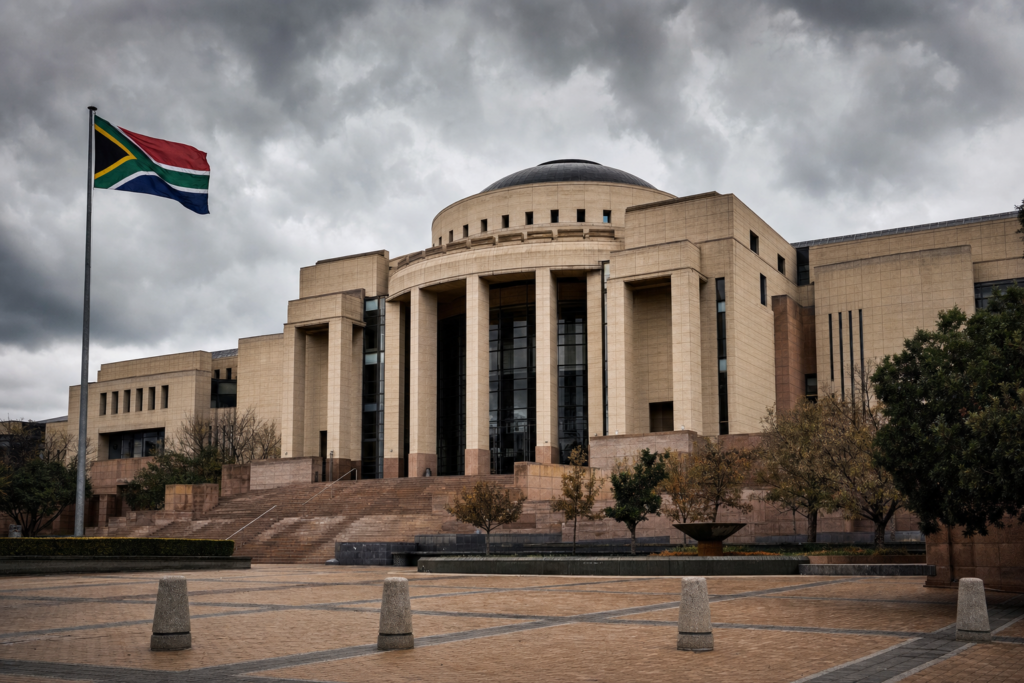
South Africa’s Constitutional Court delivered a landmark ruling on Friday, May 8, declaring unconstitutional and invalid the National Assembly’s December 2022 vote that had blocked an impeachment inquiry into President Cyril Ramaphosa. The court’s decision ordered that an independent panel’s report — which had found Ramaphosa had a case to answer — be sent directly to an impeachment committee in parliament, reopening one of the country’s most politically charged legal battles.
Chief Justice Mandisa Maya, reading from the bench in Johannesburg, declared the December 13, 2022 parliamentary vote inconsistent with the South African Constitution, effectively setting it aside. The court determined that the National Assembly’s move to dismiss the independent panel’s recommendations had been unlawful and that the process must now proceed as the panel had originally prescribed.
The case stems from an incident in 2020 when cash — reported by a former intelligence official to total roughly $4 million in foreign currency — was allegedly stolen from Ramaphosa’s privately owned Phala Phala game farm in the Limpopo province. Ramaphosa has acknowledged a theft occurred but disputes the amount, placing the figure at approximately $580,000, which he said represented proceeds from a sale of buffalo on the property to a Sudanese businessman. Critics questioned why such a large sum was stored in furniture at a farm rather than deposited in a financial institution, and whether the president had properly disclosed the funds.
In June 2022, Arthur Fraser, the former director-general of the State Security Agency, filed a formal complaint accusing Ramaphosa of attempting to conceal the theft. Parliament subsequently commissioned an independent panel, led by former Chief Justice Sandile Ngcobo, to assess whether there were grounds for an impeachment inquiry. The Ngcobo panel concluded there was sufficient evidence to suggest Ramaphosa may have breached his oath of office, and recommended that parliament proceed with a formal impeachment inquiry.
Instead, in December 2022, Ramaphosa’s African National Congress used its then-commanding parliamentary majority to vote against the panel’s recommendation, with 214 members opposing and 148 in favor of establishing an impeachment committee. That vote has now been declared void by the Constitutional Court. The court’s Friday order requires the Ngcobo panel report to be forwarded to an impeachment committee, which will examine the evidence and determine whether to advance formal proceedings. Analysts caution that even if the committee recommends impeachment, removing Ramaphosa from office would require a two-thirds majority in the National Assembly — a threshold that remains out of reach because the ANC still holds well over one-third of seats, even after losing its outright majority in the 2024 general election.
The Economic Freedom Fighters, led by Julius Malema, and the smaller African Transformation Movement brought the legal challenge to the Constitutional Court in 2024 following the ANC-controlled parliament’s dismissal of the panel findings. Malema, speaking outside the court in Johannesburg, said Ramaphosa should step aside and devote his attention to the impeachment process, calling it a matter with serious personal consequences for the president. Geordin Hill-Lewis, leader of the Democratic Alliance — the second-largest party in the ruling coalition government — called on lawmakers to conduct the impeachment committee’s work properly, rationally, and constitutionally, emphasizing the need to uphold the rule of law. Ramaphosa’s office issued a statement saying the president respects the court’s judgment and affirming that no individual is above the law.
Lawson Naidoo, executive secretary of the Council for the Advancement of the South African Constitution, said the impeachment committee’s work is expected to be detailed and could take several months before any determination is reached on whether to proceed further. Political analysts widely agree that Ramaphosa is unlikely to be removed from office given the arithmetic in parliament, but the proceedings themselves could damage the ruling party’s standing ahead of future elections and force Ramaphosa to spend political capital defending his conduct.
The scandal, dubbed Farmgate in South African media, has shadowed Ramaphosa’s presidency since 2022. He assumed the presidency in 2018 and was seen as a reformist successor to a scandal-plagued previous administration. The Constitutional Court ruling marks the first time the country’s highest court has directly intervened in an impeachment process and is being watched by legal scholars across sub-Saharan Africa as a test of constitutional accountability for sitting heads of government.
For South Carolina’s federal delegation, this story connects to a longstanding area of focus for Sen. Lindsey Graham, who serves on the Senate Armed Services Committee and has been a consistent voice on U.S. policy in Africa. South Africa is a significant trading partner for American companies, and political instability from a prolonged impeachment process could affect investor confidence in the continent’s most industrialized economy. Rep. William Timmons of SC-4, whose district covers Greenville-Spartanburg, sits on the House Financial Services Committee, where emerging-market stability and international investment risk are regularly examined.