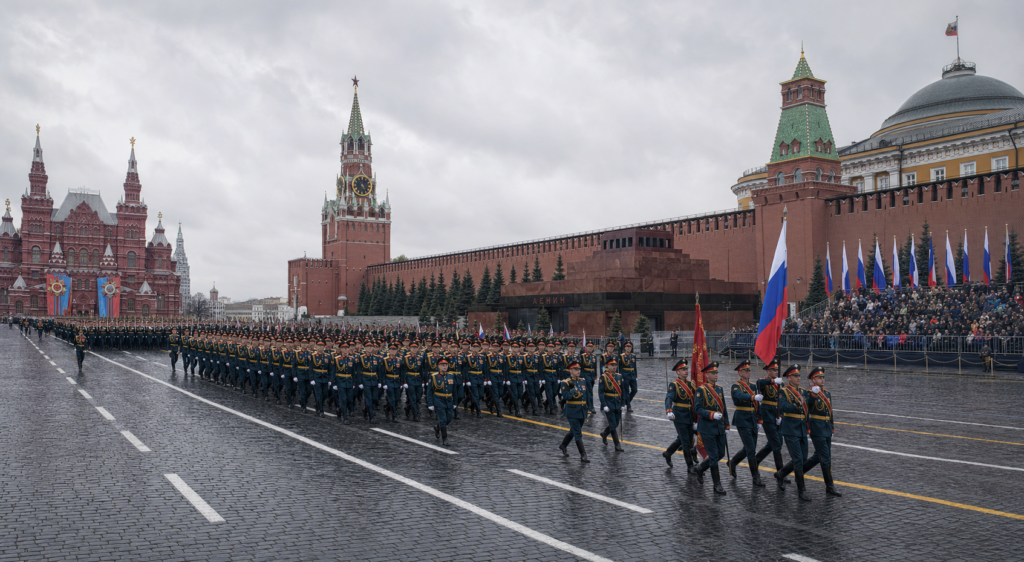
Russia’s annual Victory Day celebration in Moscow’s Red Square is proceeding this year without the tanks, missiles, and armored vehicles that have defined the commemorations for nearly two decades — the first such omission since the tradition of rolling military hardware through the capital’s historic plaza was revived in 2008.
The Russian Defense Ministry announced the decision weeks ahead of the May 9 parade, attributing the scaled-back display to what it described as the demands of the current operational situation in Ukraine — a reference widely understood to reflect ongoing concerns about Ukrainian drone strikes deep inside Russian territory. The 81st anniversary of the Soviet victory over Nazi Germany will proceed with servicemen from military educational institutions marching through Red Square, while a customary aerial flyover by military aircraft remains on the schedule.
Security analysts have noted that the absence of heavy weapons could carry significant symbolic cost for the Kremlin, which has historically relied on the spectacle of tanks and nuclear-capable intercontinental ballistic missiles rolling past Lenin’s Mausoleum to project an image of military strength at home and abroad. An associate fellow at the Royal United Services Institute said the removal of military hardware diminishes the propaganda value of the event and signals vulnerability rather than power, particularly for domestic audiences the Kremlin has worked to keep unified around the four-year-old war in Ukraine.
Ukrainian forces have conducted repeated drone incursions deep within Russian borders in recent months, targeting sites in the Samara region, the Perm area, and the Baltic port of Ust-Luga. Kremlin spokesperson Dmitry Peskov characterized these operations as acts of terrorism and said all measures were being taken to minimize the danger. Russian cellphone providers were reported to have alerted users in Moscow and St. Petersburg about coming restrictions on mobile and internet service ahead of the holiday — a precaution previously used to limit Ukrainian drone operators’ ability to guide strikes through GPS-dependent systems.
The parade’s scale stands in stark contrast to last year’s 80th anniversary event, when Russia mounted what observers described as its most ambitious Victory Day showcase in years. That parade featured more than 11,500 troops, over 180 pieces of military hardware including T-90M main battle tanks and RS-24 Yars nuclear-tipped intercontinental ballistic missiles, and troops from 13 foreign nations including China, Egypt, Vietnam, and Myanmar. The Kremlin had used the event to underscore a broad coalition of countries willing to stand alongside Moscow despite Western sanctions and diplomatic pressure.
This year, Slovakia’s Prime Minister Robert Fico is again expected to attend, having become the first leader from a European Union or NATO member nation to join the celebrations since Russia launched its full-scale invasion of Ukraine in early 2022. His attendance has drawn criticism from EU foreign policy officials, who have urged member states to refrain from lending legitimacy to the event.
Russia’s Defense Ministry also declared a brief unilateral ceasefire in Ukraine for the Victory Day period, covering Friday and Saturday. Ukrainian President Volodymyr Zelenskyy announced that Ukrainian forces would observe a halt beginning at midnight on Wednesday, but questioned the sincerity of Russia’s gesture. Zelenskyy told allied leaders at a summit that Moscow’s decision to strip the parade of military vehicles reflected the toll the war has taken, arguing that Russian officials feared Ukrainian drones could appear over Red Square on May 9. He urged continued international pressure and expanded sanctions rather than easing diplomatic isolation of Moscow around the holiday.
For South Carolina’s congressional delegation, the parade’s altered character fits into a broader pattern of scrutiny over U.S. policy toward Russia and the conflict in Ukraine. Sen. Lindsey Graham, who serves on the Senate Armed Services Committee and has been among the most outspoken advocates of continued U.S. support for Ukraine, has long argued that any appearance of Western accommodation toward Moscow emboldens the Kremlin. Graham has previously pressed the Trump administration to maintain military aid and sanctions as conditions for any negotiated settlement. Rep. William Timmons, who represents Spartanburg in South Carolina’s 4th Congressional District and sits on the House Oversight Committee, has backed continued pressure on Russia in line with his party’s broader defense-oriented posture.
The decision to forgo heavy weapons at Victory Day also comes as U.S. President Donald Trump and Putin have remained in contact over a potential Ukraine ceasefire framework. A presidential advisor said Trump endorsed the idea of a Victory Day pause when Putin raised it in a phone call, noting that the holiday represents, in the advisor’s words, a shared moment of victory over fascism in World War II. No formal agreement has been announced.
Russia’s Victory Day parade has served as a key ritual of national identity since the Soviet era, commemorating the German Instrument of Surrender on May 8, 1945 — received in Moscow time as May 9. Putin has made the holiday a centerpiece of his political identity over more than two decades in power, regularly using the occasion to link Russia’s current military operations in Ukraine to what he characterizes as a continuous struggle against fascism and foreign aggression. Critics and Western analysts have consistently described that framing as historical revisionism.