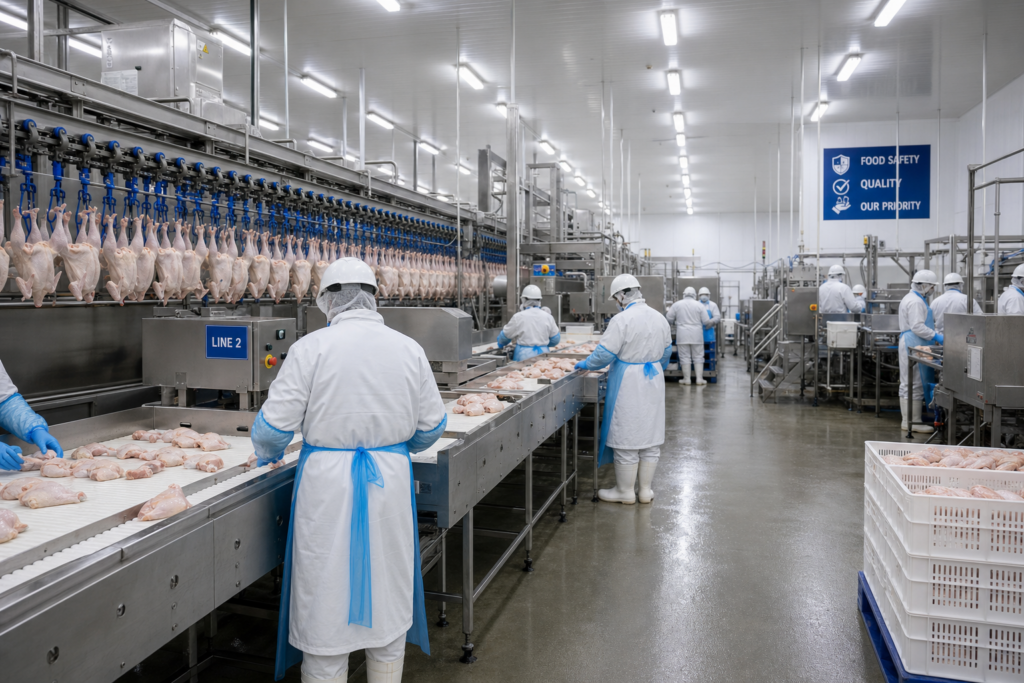
The Justice Department and six states reached a proposed settlement with Agri Stats, an Indiana-based data company that services the meatpacking industry, in a case the federal government says contributed directly to higher grocery prices for chicken, pork, and turkey across the country.
The agreement, announced May 7, resolves a civil antitrust lawsuit the DOJ first filed in September 2023. The case accused Agri Stats of collecting nonpublic pricing and production data from meat processors and distributing detailed industry reports that allowed processors to coordinate pricing strategies — keeping consumer prices artificially elevated while limiting the information available to the grocery stores, restaurants, and other buyers on the other side of the transaction.
What the Settlement Requires
Under the proposed judgment, Agri Stats would be prohibited from offering sales report books and barred from sharing sales data in the broad format it previously used. The company would be prevented from disclosing company rankings, revealing the identities of data contributors, or reporting plant-level and business-unit-level information except under narrowly defined circumstances.
Critically, the settlement would require Agri Stats to make its reports available for purchase to any buyer in the United States — including grocery retailers and restaurant chains — on terms no less favorable than those it currently offers to meat processors. That provision is central to what the Justice Department says was the core competitive harm: a data asymmetry that gave processors visibility into market conditions that buyers could not access.
Additional compliance measures include requirements that some reports contain data from at least three meat processors, limits on reporting recent production data, and confidentiality protections on contributor information. A court-appointed monitor would oversee Agri Stats’ compliance with the terms for up to seven years. The company would also be required to implement an internal antitrust compliance program covering employee training, whistleblower protections, and mandatory disclosure of potential violations.
The settlement agreement must still be approved by the federal judge overseeing the case, which had been scheduled to go to trial May 18. The states joining the DOJ in the settlement are California, Minnesota, North Carolina, Tennessee, Texas, and Utah.
Broader Meat Industry Context
Acting Attorney General Todd Blanche called the Agri Stats deal a historic step in efforts to make food more affordable. The administration has framed the settlement as part of a wider effort to address concentration across meat and protein markets.
Separately, the DOJ is conducting a criminal investigation into potential antitrust violations in the beef processing sector. That inquiry came after President Donald Trump, at the end of 2025, directed the administration to probe whether foreign-owned meatpackers were driving up U.S. beef prices. Four companies control more than 85 percent of U.S. beef processing capacity, roughly half of which is foreign-owned, according to administration officials.
Beef prices have been climbing steadily since 2020. In March, the average price for a pound of ground beef reached $6.70 — a 16 percent increase compared to the same period a year earlier, according to federal government data. Analysts point to multiple factors, including a historically small U.S. cattle herd and restrictions on livestock imports from Mexico that have been in place since late 2024 to prevent the spread of the New World screwworm parasite.
South Carolina’s Poultry Sector Watching Settlement
The Agri Stats settlement targets the chicken and turkey industries specifically — sectors where South Carolina has a significant economic stake. Amick Farms, founded in Batesburg in 1941 and headquartered there today, is one of South Carolina’s largest poultry processors, operating an integrated complex with more than 3,000 employees and more than 300 family farm partners across the state. The company produces over a billion pounds of chicken products annually and distributes across 40 states.
House of Raeford Farms, which operates a major processing complex in West Columbia under the Columbia Farms brand, is another SC-based poultry operation with production infrastructure including a feed mill and hatchery in Monetta. Both companies operate in the broiler chicken segment — exactly the market at the center of the Agri Stats lawsuit.
South Carolina is one of the top poultry-producing states in the Southeast. The state’s chicken processors, contract growers, and farm supply networks all operate within pricing structures shaped at least in part by industry data systems like Agri Stats. If the settlement succeeds in rebalancing data access between processors and buyers, it could influence how chicken pricing is negotiated throughout the supply chain — including with the independent family farmers who raise birds under contract in South Carolina’s rural counties.
Senator Tim Scott, who sits on the Senate Finance Committee and has been an advocate for addressing food price inflation, has previously backed administration efforts to use antitrust enforcement as a tool against rising consumer costs. Representative William Timmons, who represents Spartanburg and Greenville counties in the SC-4 district, serves on the House Financial Services Committee, which has jurisdiction over economic competition policy.