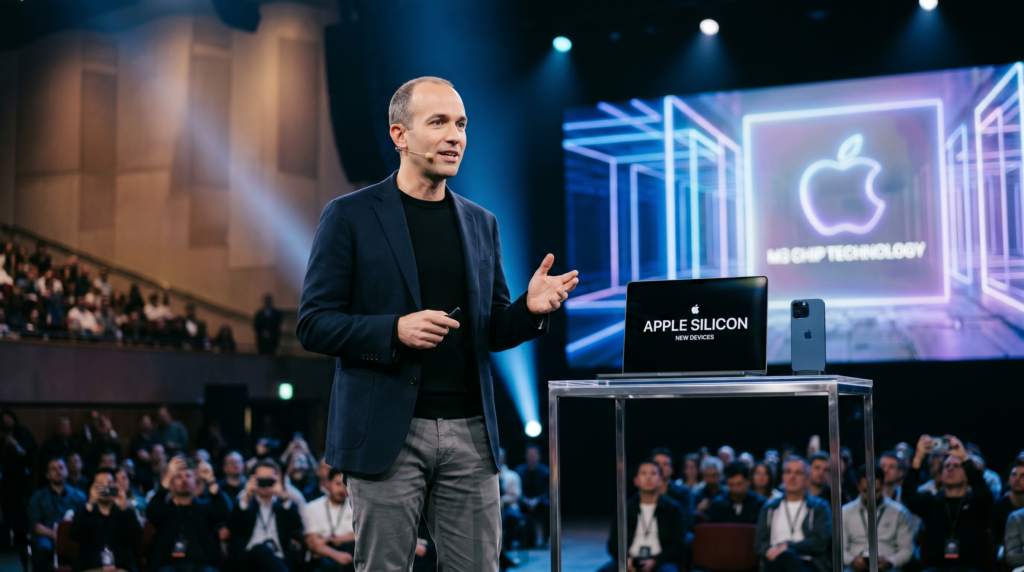
Apple is entering a new chapter, and for the first time in more than a decade, a hardware engineer will be sitting in the top chair. John Ternus, the company’s longtime senior vice president of hardware engineering, will officially take over as chief executive officer on September 1, succeeding Tim Cook, who will remain involved as executive chairman of the board.
The transition marks one of the most significant leadership shifts in the technology industry in years. Cook spent nearly 15 years building Apple into a company with a market capitalization that crossed $4 trillion, expanding its services arm and positioning the device maker as one of the most profitable businesses on the planet. Ternus brings an entirely different profile to the role. He joined Apple in 2001 after earning a mechanical engineering degree from the University of Pennsylvania and has spent virtually his entire career working on the hardware that defines the company’s product lineup — iPhone, Mac, iPad, Apple Watch, AirPods, and Vision Pro.
His elevation signals that Apple’s board wants hardware ambition, not just operational efficiency, steering the company into whatever comes next.
A Hardware-First Bet on AI’s Physical Future
The defining strategic question for Apple right now is where it fits in an industry rapidly reorganizing around artificial intelligence. Ternus is expected to answer that question by betting on the device itself rather than the underlying model. Rather than racing to build the most capable large language models, his instinct — shaped by decades designing physical products — appears to be to focus on making AI tangible: something you hold, something you wear, something that lives in your home.
Reports have circulated about a slate of new product categories that Ternus may accelerate. Those include smart glasses, a wearable pendant with a built-in camera designed to act as an ambient AI companion, and a new generation of AirPods capable of running AI-powered features on-device. The through-line connecting all of these is the iPhone, which would serve as the hub for an expanding ring of Apple hardware — with Siri, upgraded through a Google Gemini AI framework, playing a central role.
Ternus is also expected to move decisively on a product category that has languished in planning stages for years: a foldable iPhone. Competitors have already shipped folding devices, but Apple has delayed, holding to its standard of waiting until the technology clears the bar it sets for durability and user experience. A September launch has been widely anticipated, which means Ternus will have his fingerprints on the product from day one as CEO.
Perhaps the most speculative territory on the roadmap involves robotics. Ternus has long been interested in the field — his senior project in college involved building a mechanical feeding arm that allowed quadriplegics to control movement using head motions. Internal exploration at Apple has apparently included a tabletop device with a robotic arm attached to a display that could physically orient itself toward the user, as well as mobile robots designed to move through a home and handle simple tasks. Humanoid robot concepts have also been explored, though any such product is likely years from market reality.
Apple Silicon and the Chip Advantage
One area where Ternus’s fingerprints are already deeply embedded is Apple’s custom silicon program. He was directly involved in the company’s decision to transition away from Intel processors beginning in 2020 and move all Mac products to its own chip architecture. That effort produced the M-series chips that now power the Mac lineup, and the A-series chips that run iPhone and iPad. The strategic importance of that shift has grown steadily: by designing its own processors, Apple controls performance, power efficiency, and the on-device capabilities needed to run AI features without sending data to the cloud.
The M5 chip series, now rolling out across the Mac lineup, continues that trajectory. The Neural Engine at the core of Apple’s silicon is capable of running transformer-based AI models on-device — a capability that matters enormously for privacy-sensitive users and for devices operating without reliable internet connectivity. For Ternus, who helped drive the silicon independence strategy, the custom chip program is both a competitive advantage and a foundation for every new product category he may pursue.
Supply Chain Headwinds
The new CEO will not inherit an easy operating environment. Tariff pressures, ongoing memory chip shortages, and the company’s historical reliance on Chinese manufacturing factories present real near-term challenges. Roughly 80 percent of iPhones were produced in China before recent tariff escalations prompted the company to accelerate a geographic shift. Apple made approximately 25 percent of its iPhones in India last year, a share the company has been working to grow as it reduces its exposure to single-region manufacturing risk.
Simultaneously, Apple is navigating political pressure in the United States to bring more production onshore, having announced a $500 billion domestic investment pledge. Johny Srouji, who was promoted to a newly created chief hardware officer role as part of the same leadership reshuffling that elevated Ternus, will oversee Apple’s custom silicon roadmap and hardware engineering teams — a structure designed to give Ternus headroom to think strategically without losing the engineering talent that makes the chip program possible.
What It Means for Spartanburg County’s Tech Pipeline
Apple’s pivot toward hardware-led AI is not an abstract Silicon Valley story for Spartanburg County. The Upstate’s higher education institutions and workforce development organizations have spent recent years deliberately building the technical talent base that companies hiring in the artificial intelligence and advanced manufacturing space are looking for.
USC Upstate’s Department of Mathematics and Computer Science offers degree programs in Computer Science, Computer Information Systems, and Cybersecurity, and the university recently posted openings for a computer science instructor and an artificial intelligence developer — positions that reflect the kind of demand Apple’s hardware-AI strategy is generating across the industry. Wofford College, in downtown Spartanburg, offers a bachelor of science in computer science that has been placing graduates into software engineering and data roles in the Greenville-Spartanburg metro.
Spartanburg Community College’s Center for Advanced Manufacturing and Industrial Technologies — known as CAMIT — prepares students for exactly the kind of precision manufacturing and mechatronics work that underpins hardware production at scale. Programs in mechatronics, automated manufacturing technology, and precision machining mirror the skills that supply chains serving major technology assemblers require as Apple works to diversify its manufacturing geography.
OneSpartanburg, Inc., the county’s economic development organization, has been actively working to match local talent with employers competing for technical workers. Its EDGE program, announced in April 2026, formalized efforts to connect Spartanburg County youth with paid internships and apprenticeships — a pipeline that now includes more than 600 positions annually. OneSpartanburg’s talent toolkit explicitly supports recruiting from USC Upstate, SCC, Wofford, Converse, and Spartanburg Methodist College, a network of institutions positioned to supply the technical workforce that a hardware-focused technology sector demands.
Rep. William Timmons, whose SC-4 district covers Spartanburg County and sits on the House Financial Services and Oversight committees, has backed domestic technology investment as part of broader economic competitiveness arguments. Apple’s $500 billion U.S. investment commitment — and its implications for American semiconductor and device manufacturing — falls squarely within the policy debate his committees oversee.
The era of Apple as a services-and-operations company is giving way to something more hardware-intensive, more device-centric, and more dependent on the kind of engineering talent that Upstate South Carolina has been working methodically to cultivate.