A Spartanburg County data center that secured one of the most generous tax packages in local history is now seeking a dramatic expansion of its power capacity — before it has opened its doors.
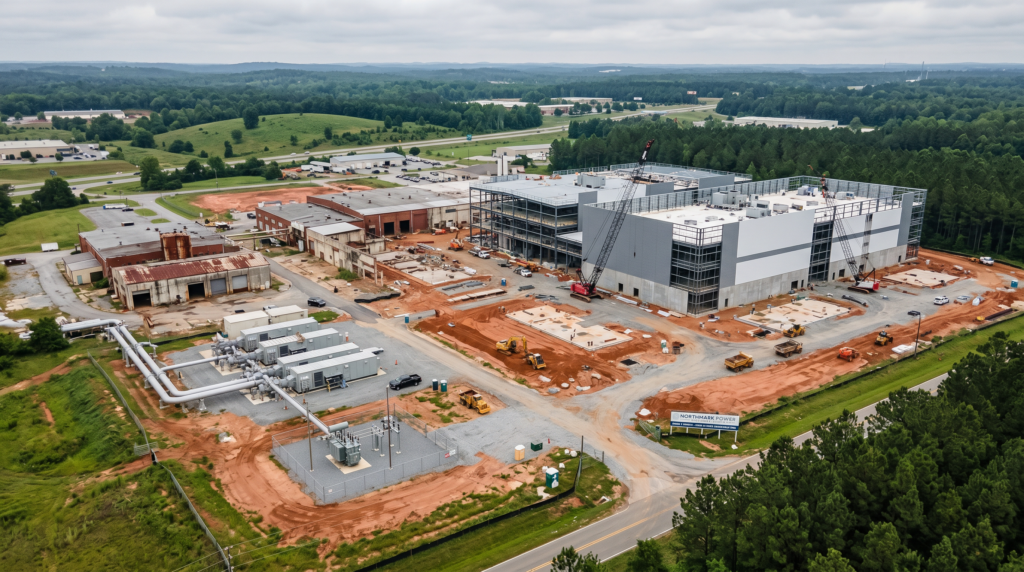
NorthMark Strategies, the New York-based investment firm building a high-performance computing facility at 4000 South Pine Street, has applied for a 400-megawatt increase in power generation capacity. The facility, known internally as Project Moc-1, is not yet operational; initial operations are targeted for the third quarter of 2026.
The $2.8 billion project — the second-largest single investment in South Carolina history — involves converting the former Kohler manufacturing plant, which closed in 2024 after 66 years, into a supercomputing and artificial intelligence campus. NorthMark, through its subsidiary Valara Holdings, is developing the site in three phases, beginning with a 350,000-square-foot warehouse and eventually expanding into the adjacent 500,000-square-foot manufacturing plant.
When NorthMark pitched the project to county officials in early 2025, a central assurance was that the facility would self-generate power through an adjacent natural gas pipeline, avoiding strain on the local grid. A 400-megawatt expansion — equivalent to the supply needed to power roughly 160,000 homes — represents a significant shift from that framing.
Spartanburg County Council approved a 40-year fee-in-lieu-of-taxes agreement locking NorthMark’s property assessment ratio at 4 percent, compared with the standard commercial rate of 10.5 percent. The deal also includes up to $2 million per year in Special Source Credits. County Councilman David Britt and Gov. Henry McMaster both endorsed the project when it was announced in April 2025.
The expansion application has drawn sharp criticism from residents near South Pine Street, who have raised concerns about around-the-clock natural gas combustion, noise, and the potential for future energy costs to fall on residential ratepayers. Despite a total commitment of $2.8 billion, the project is slated to create just 27 permanent full-time jobs.