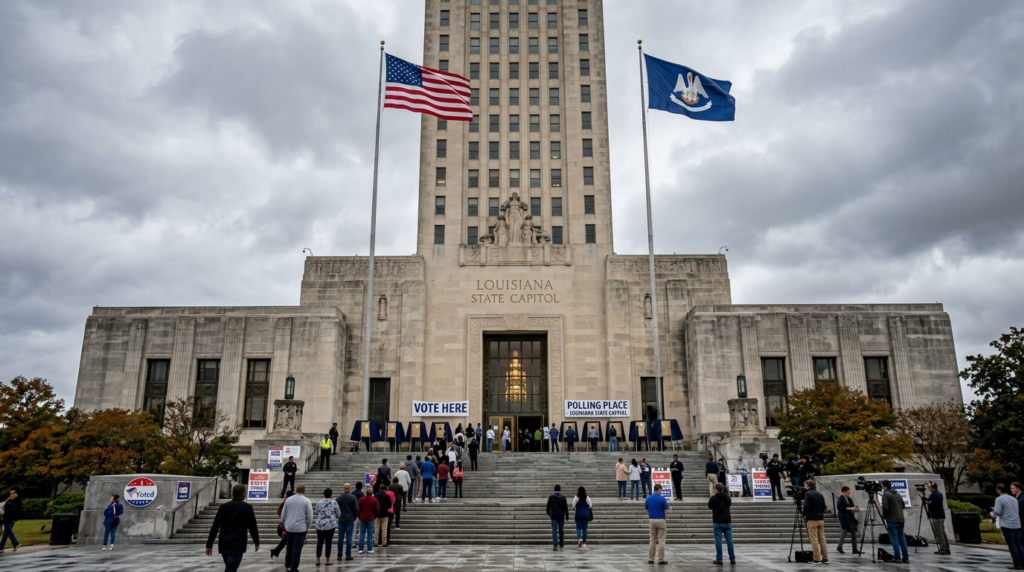
Louisiana suspended its U.S. House primary elections Thursday, less than two weeks before voting was set to begin, after the Supreme Court ruled the state’s congressional map an unconstitutional racial gerrymander — a decision that scrambles midterm election timelines and carries direct implications for southern states with similar district designs.
Governor Jeff Landry issued an executive order halting only the House races, citing a state law that empowers the governor to suspend elections when an electoral emergency is certified. Secretary of State Nancy Landry, who is not related to the governor, provided that certification and announced that notifications would be posted at all early voting sites explaining that votes cast in the suspended House races will not be counted. Other elections scheduled for May 16 — including a contested Senate primary — will proceed as planned, with early voting beginning Saturday.
The Supreme Court’s ruling, issued Wednesday in the case known as Louisiana v. Callais, found that the state’s most recent congressional map — drawn in 2024 under Senate Bill 8 during an extraordinary session — constituted an unconstitutional gerrymander. The court’s decision effectively reinstated a lower court injunction that had previously barred elections under those boundaries. The ruling focused on one of Louisiana’s two Democratic-majority districts, which is predominantly composed of Black voters. Republicans in the legislature are now expected to redraw those boundaries in a way that would eliminate at least one Democratic-held seat before the fall general election.
President Trump praised Governor Landry’s swift action, and House Speaker Mike Johnson called the suspension unavoidable given that the courts had just declared the map unlawful. Early voting for the May 16 primary was set to begin Saturday, and absentee ballots had already been dispatched — meaning the disruption arrives as some voters had already prepared to cast votes that would carry no legal effect.
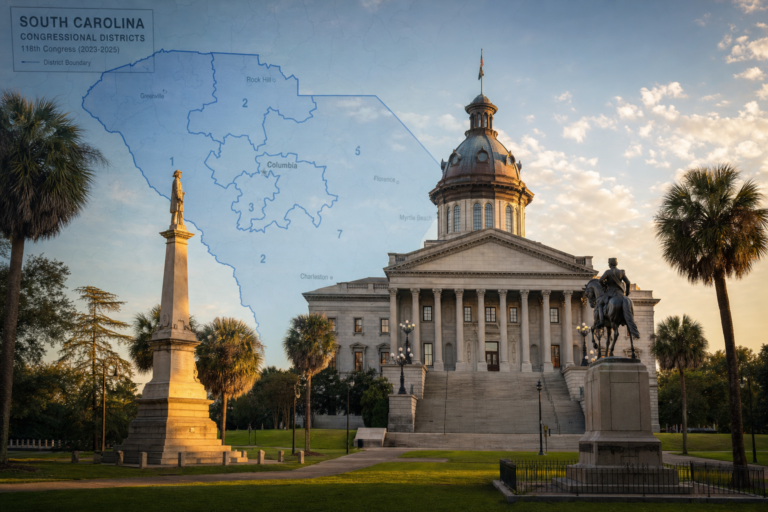
The ruling’s implications extend well beyond Louisiana. Legal analysts noted that the Callais decision weakened the Section 2 protections of the Voting Rights Act that had previously been used to compel majority-minority district designs, potentially opening the door for Republican-controlled legislatures in other southern states to redraw maps ahead of November. South Carolina sits in that category. SC-6, the district represented by Rep. James Clyburn, is the state’s majority-minority district and was drawn under similar legal logic. Sen. Lindsey Graham, who sits on the Senate Judiciary Committee, has long argued that court-mandated racial gerrymandering produces its own constitutional problems, a position the Callais ruling now substantially reinforces.