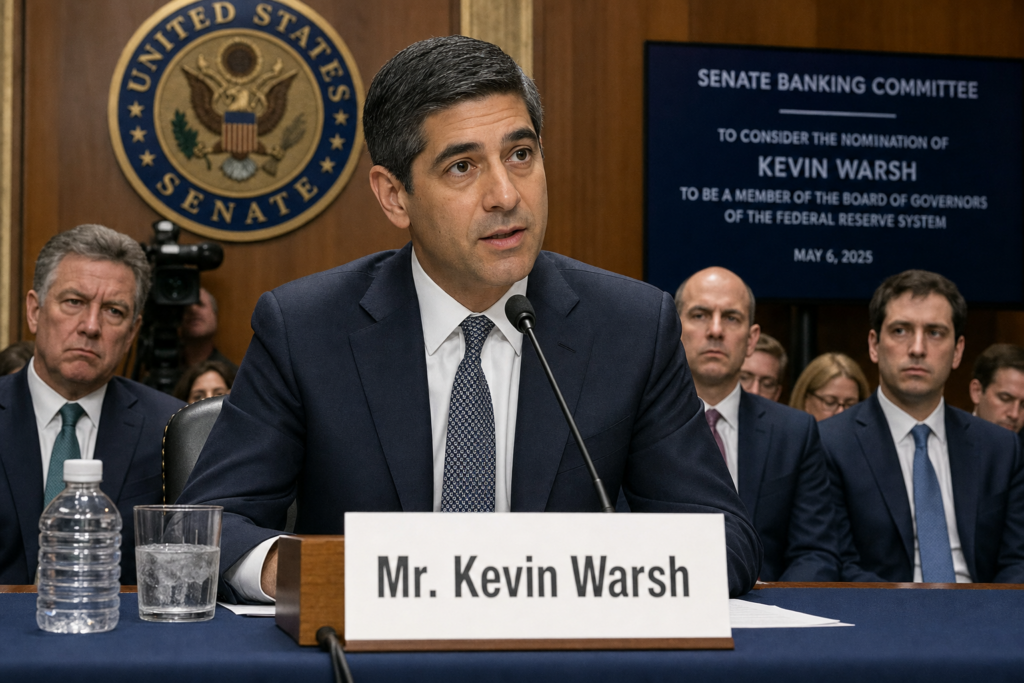
The Senate voted 54-45 on Wednesday to confirm Kevin Warsh as the 17th chair of the Federal Reserve, handing President Trump a significant victory and marking the most narrowly confirmed Fed chair since the Senate began requiring approval for the role in 1977. Warsh, 56, succeeds Jerome Powell, whose term as chair ended Friday, and will preside over his first rate-setting meeting on June 16-17.
The vote fell almost entirely along party lines. Every Republican senator voted in support of Warsh, including South Carolina’s Tim Scott and Lindsey Graham. Senator John Fetterman of Pennsylvania was the lone Democrat to cross party lines and back the nomination. Kirsten Gillibrand of New York did not vote.
The confirmation carries particular weight in South Carolina through Tim Scott, who chairs the Senate Banking Committee and was a central advocate for Warsh throughout the process. Scott’s committee advanced the nomination on a party-line vote of 13-11 on April 29, and Scott called Warsh battle-tested and ready to lead the Federal Reserve. Scott had previously expressed concern about political pressure on the Fed, saying the central bank must remain independent and accountable — statements Democrats later highlighted as they argued Warsh would bend to White House influence.
Opposition to the nomination was fierce. Senator Elizabeth Warren, the Banking Committee’s top Democrat, called Warsh a sock puppet for Trump and warned colleagues that backing the nomination would facilitate a White House takeover of the central bank. The confirmation process was the most contentious for any Fed chair on record, with Warsh navigating a side controversy involving a Justice Department inquiry into Powell’s handling of a Capitol renovation project — an investigation critics and a federal judge called a pretext to pressure Powell into cutting rates. The DOJ closed the inquiry in April, clearing the path for Warsh’s final confirmation vote.
Warsh brings a hawkish and reform-minded profile to the role. A former Fed governor who served on the Board from 2006 to 2011, he has been outspoken in his criticism of the central bank’s response to the inflation surge of 2021-22. He has called for a regime change at the Fed, suggested limiting the bank’s quarterly rate-forecast communications, and proposed shrinking the Fed’s balance sheet to give the institution more room to cut the policy rate over time. His four-year term as chair runs until 2030, and he was separately confirmed Tuesday to a 14-year seat on the Fed’s Board of Governors.
The rate environment Warsh inherits is complicated. Consumer prices rose 0.6 percent in April and 3.8 percent year-over-year — well above the Fed’s 2 percent target and following a 0.9 percent monthly increase in March. Markets currently place a 97 percent probability on rates staying steady at the June meeting, with the current target range at 3.50 to 3.75 percent. Three members of the rate-setting committee dissented at the most recent meeting against language that suggested a rate cut was coming, while a fourth — Stephen Miran, appointed by Trump — has consistently pressed for cuts since taking his board seat last September.
For Upstate South Carolina, the Fed’s rate decisions carry direct economic weight. BMW Manufacturing in Spartanburg County — the automaker’s largest single production facility in the world — has signaled it is evaluating whether to expand output at the plant by as many as 80,000 additional vehicles annually. That kind of capital investment is highly sensitive to borrowing costs and to the broader business confidence that comes with monetary policy stability. Boeing’s 787 Dreamliner assembly operation in North Charleston employs thousands and has generated a regional employment multiplier across the Charleston metro area that researchers at the Federal Reserve Bank of Richmond documented as significant. Both operations plan capital investment cycles that depend in part on where interest rates are heading and how predictable Fed policy will be under new leadership.
Spartanburg Regional Health System and other large regional institutions that finance capital projects through bond markets also track the Fed’s rate trajectory closely, as higher long-term rates raise the cost of hospital expansions, facility upgrades, and equipment procurement.
Warsh has committed to divesting assets — including disclosed holdings in Polymarket and SpaceX — within 90 days of taking office. He has declined to fully disclose the size of those holdings beyond confirming a net worth of at least $100 million, a point Democrats pressed during confirmation hearings. Whether he governs the central bank as an independent steward or aligns Fed policy with the White House’s preference for lower rates will be the defining question of his tenure — one that South Carolina’s manufacturing economy will be watching with a direct financial stake in the answer.