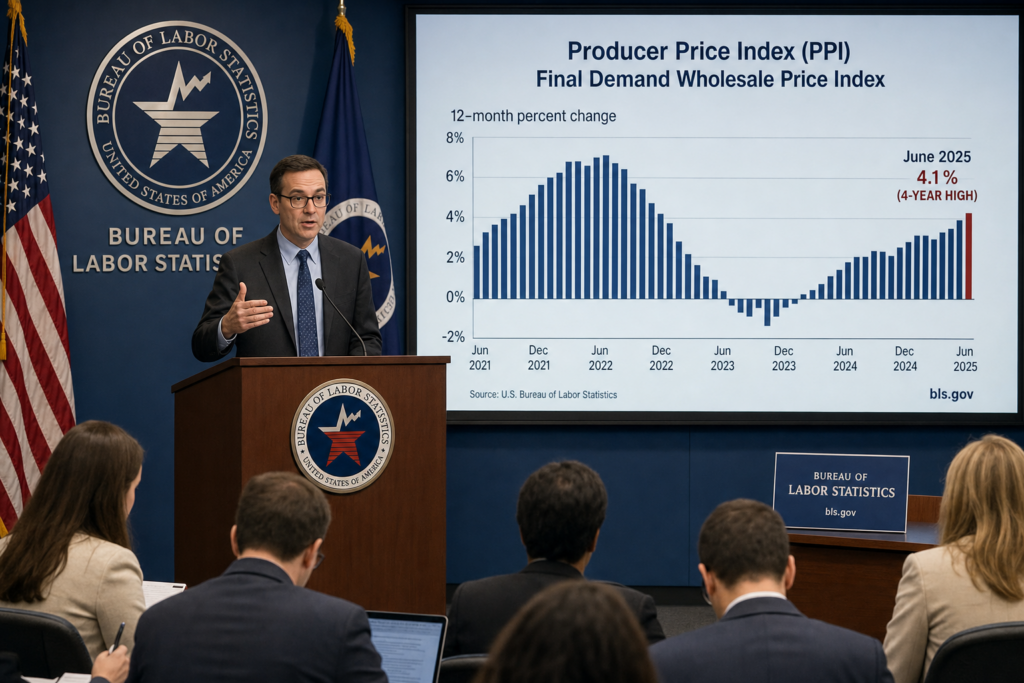
Wholesale prices in the United States jumped 6.0 percent over the past 12 months through April, federal labor economists reported on May 13, marking the largest year-over-year increase since December 2022 and pushing the Producer Price Index to its highest level in more than four years. On a monthly basis, the PPI climbed 1.4 percent in April alone — the sharpest single-month advance since March 2022 — nearly tripling the month-over-month pace recorded in February and doubling the March gain.
Energy prices were the primary accelerant. Within final demand goods, energy costs surged 7.8 percent in April, accounting for more than three-quarters of the 2.0 percent rise in the goods component. Gasoline led that charge with a 15.6 percent monthly spike, while jet fuel, diesel, and industrial chemicals also climbed sharply. Unprocessed goods for intermediate demand — the raw material inputs that feed into manufacturing pipelines — rose 4.1 percent for the month, with crude petroleum up 11.3 percent, marking the sixth straight monthly increase in that category. On a 12-month basis, prices for unprocessed intermediate goods have soared 20.9 percent, the steepest such gain since September 2022.
Services inflation is also broadening. The services component of the PPI rose 1.2 percent in April — its largest monthly gain since March 2022 — with nearly two-thirds of that increase driven by a 2.7 percent jump in trade service margins. Transportation and warehousing costs climbed 5.0 percent for the month, while truck freight rates moved higher in intermediate demand, signaling that distribution and logistics costs are filtering throughout supply chains.
The report carries direct implications for Spartanburg County‘s manufacturing base, which ranks among the most exposed in the Southeast to upstream wholesale cost pressures. BMW Manufacturing, whose Plant Spartanburg exported nearly $9 billion in vehicles in 2025 to remain the nation’s top automotive exporter by value, sources components and energy inputs that track the categories recording the steepest PPI gains — industrial chemicals, freight, and processed goods. Michelin’s North American tire manufacturing operations in Spartanburg and Anderson counties rely heavily on petroleum-derived feedstocks, where intermediate processed goods are now up 9.4 percent over 12 months. Milliken and Company, the Spartanburg-based textile and specialty chemicals manufacturer, faces elevated cost pressure across both the chemical inputs used in specialty products and the freight rates needed to move them. The Inland Port Greer, which connects Upstate manufacturers to the Port of Charleston, routes goods whose logistics costs have surged alongside truck freight and container handling margins.
At the federal monetary policy level, the April PPI data compounds an already difficult environment for the Federal Reserve. Wall Street forecasters have sharply revised rate-cut outlooks in response to persistent inflation, with traders now pricing the next Federal Reserve cut in mid-to-late 2027 according to interest-rate futures pricing. Chicago Federal Reserve President Austan Goolsbee said on May 8 that all options remain on the table for monetary policy — including rate increases. Elevated benchmark rates mean that capital investment decisions for Spartanburg’s manufacturers remain constrained: higher borrowing costs delay equipment purchases, facility expansions, and workforce additions.
The April PPI data beat analyst expectations significantly. The consensus estimate had projected a 4.9 percent year-over-year gain; the actual print of 6.0 percent exceeded that forecast by more than a full percentage point. Core PPI, excluding food and energy, rose 5.2 percent year-over-year. The next federal wholesale-price report is scheduled for June 11, covering May 2026 data.