South Carolina Gov. Henry McMaster announced Wednesday that he will call a special session of the General Assembly to redraw the state’s seven congressional districts, reviving a Republican push that collapsed in the state Senate earlier this week and setting up a map fight that could reshape every corner of the state’s political geography — including the Upstate district that covers Spartanburg County.
McMaster said the special session will be formally called at 5:01 p.m. Thursday, the moment after the Senate adjourns its regular session. The House is expected to reconvene Friday, with the Senate returning the following Monday. Under a special session, each chamber needs only a simple majority to pass new district lines — a lower bar than the two-thirds threshold that killed the effort Tuesday when five Republican senators sided with Democrats to block a procedural vote 29-17.
The driving force behind the push is a rapid reshaping of the legal landscape that governs how states draw congressional maps. The U.S. Supreme Court’s Callais decision earlier this year gutted key Voting Rights Act protections that had long shielded majority-Black districts from racial gerrymandering. That ruling set off a wave of redistricting across the South, with Tennessee already enacting a new map and Alabama, Louisiana, and Mississippi moving in the same direction. South Carolina Republicans, encouraged by President Donald Trump and national party operatives, moved quickly to follow.
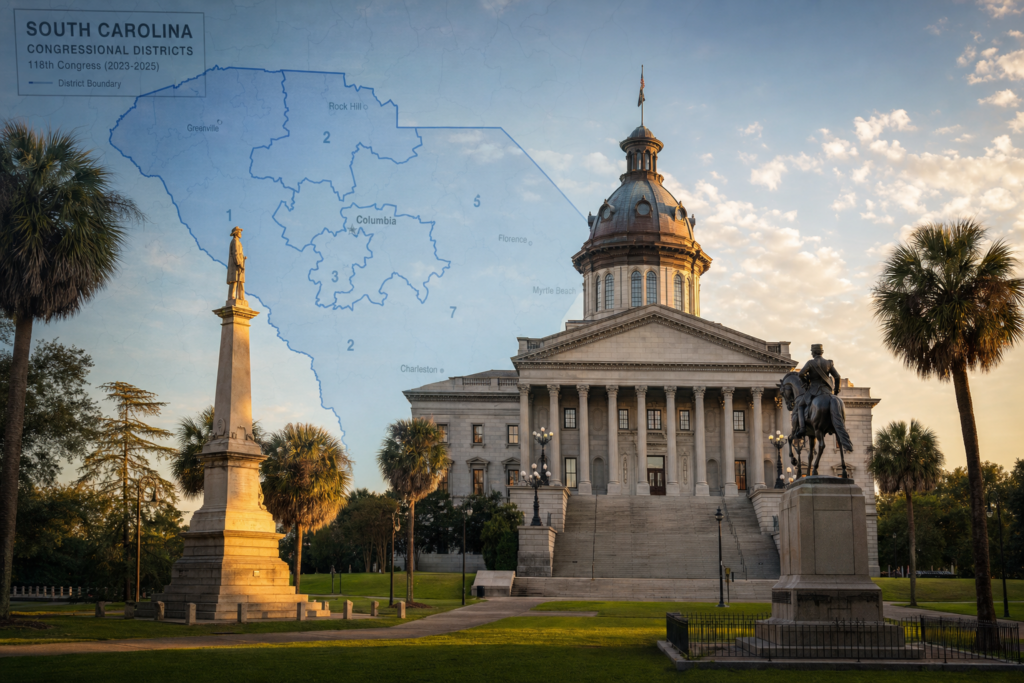
The central target in South Carolina is the 6th Congressional District, represented by Rep. Jim Clyburn, the state’s only Democrat in Congress and the sole holder of a majority-Black district in the delegation. The proposed map circulated in the state House would carve Clyburn’s district into pieces, dividing Charleston between districts 1 and 7, and splitting Richland County — home to the state capital Columbia — across three separate districts. Clyburn has said he will run on his record regardless of what the final map looks like.
For Spartanburg, the map fight carries its own stakes. The city and surrounding county currently sit entirely within the 4th Congressional District, represented by Republican William Timmons. SC-04 stretches across the Upstate foothills and takes in a majority of both Greenville and Spartanburg counties. Any redistricting effort that moves Democratic-leaning population out of SC-06 and into neighboring Republican districts could alter the balance of SC-04 and every adjacent seat, depending on how mapmakers carve up the state. Critics of aggressive redistricting have warned that redistribution of Democratic voters into suburban Republican districts could make those seats more competitive — a risk that led some Republican state senators, including Senate Majority Leader Shane Massey, to oppose the redraw.
Massey was among the five Republicans who voted with Democrats on Tuesday to block the measure. Despite opposing that vote, he has begun informing colleagues of McMaster’s decision to proceed with the special session. Whether Massey will try to flip any of the Republican senators who joined him in opposition remains uncertain heading into what is expected to be a rapid legislative process.
Rep. Nancy Mace, whose SC-01 district covers the Charleston area, said she applied direct pressure on McMaster and on Trump to ensure the special session happened, framing the move as a constitutional corrective. James Blair, departing the White House to lead midterm operations for Trump, posted publicly after Tuesday’s failed Senate vote that South Carolina was not finished with redistricting.
A successful redraw would position Republicans to pursue a 7-0 congressional delegation ahead of the November 2026 midterms, though some state Republican leaders have cautioned that no map is a guaranteed path to defeating Clyburn, who has held his seat since 1993. South Carolina’s June 9 primary elections are approaching fast; more than 8,000 absentee ballots had already been sent to military and overseas voters before Tuesday’s failed vote, and a congressional primary delay to August would cost the state roughly $2.5 million, according to the state Election Commission director.
The South Carolina General Assembly is expected to take up new maps as soon as this week once the special session is formally underway.