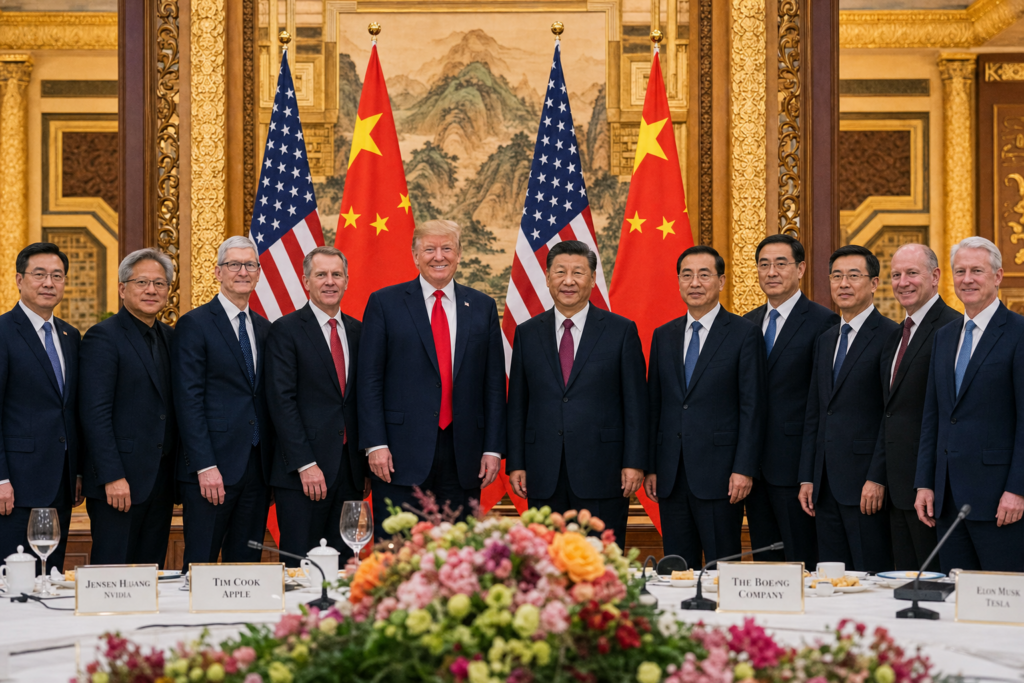
President Donald Trump arrived in Beijing on Wednesday for a three-day state summit with Chinese President Xi Jinping, bringing along more than a dozen of America’s most powerful corporate executives — a delegation whose combined net worth exceeds $1 trillion and whose companies have direct stakes in the outcome of any trade agreement reached between the two superpowers.
Jensen Huang, the chief executive of Nvidia and the leader of the world’s most valuable company, joined the delegation at the last moment after Trump personally extended the invitation by phone on Tuesday morning. Huang had been left off an earlier White House roster of 16 executives, an omission that drew attention across Silicon Valley and Washington given Nvidia’s central role in the global competition for artificial intelligence dominance. Huang boarded Air Force One during a stopover in Alaska after flying there Tuesday evening. For nearly a year, he has been working to persuade officials in both Washington and Beijing to allow Nvidia to resume selling advanced AI chips into the Chinese market.
Tesla and SpaceX chief executive Elon Musk also made the trip, marking a notable reconciliation with Trump following a public feud last summer. Apple chief executive Tim Cook — who announced last month he will step down from the CEO role on September 1, with hardware engineering chief John Ternus set to succeed him — joined as well. Cook has spent years navigating Apple’s deep manufacturing and sales ties to China, successfully securing tariff exemptions in recent years after committing to a $600 billion U.S. investment pledge.
Boeing chief executive Kelly Ortberg rounded out the aerospace contingent. Boeing’s Charleston, South Carolina facility — the sole domestic production line for the 787 Dreamliner — has faced a severely deteriorating trade environment with China, where airlines refused deliveries of new jets after China raised retaliatory tariffs to 125 percent in early 2025. Those duties effectively more than doubled the cost of American-built jets for Chinese carriers. Ortberg is engaged in ongoing talks about a potential large commercial aircraft purchase by Chinese airlines, making his presence at the summit directly consequential for the workers assembling 787s in North Charleston.
At BMW’s Spartanburg plant — the largest BMW manufacturing facility in the world and the top U.S. vehicle exporter by value — the summit’s trade outcomes carry similarly direct weight. The Spartanburg campus produces roughly 400,000 vehicles annually, predominantly X-series SUVs, with approximately 60 percent of output shipped to global markets including China. Tariff relief or a trade-truce extension negotiated in Beijing directly affects export economics for Spartanburg-built vehicles. BMW has previously reported that total tariff headwinds cost the company approximately 1.75 billion euros in 2025. Michelin’s South Carolina facilities, including plants in Anderson and Lexington, source natural rubber globally and are likewise sensitive to supply-chain conditions shaped by U.S.-China trade policy.
The summit, held at Beijing’s Great Hall of the People beginning on the morning of May 14, marked the first U.S. presidential visit to China in nearly nine years. Xi told assembled American business leaders after the bilateral talks that China’s door would only open wider to U.S. companies. Trump and Xi met for approximately two hours — double the originally scheduled duration — discussing trade, Iran, Ukraine, and the Korean Peninsula. Trump’s stated first priority was persuading Xi to open China’s markets more broadly to American businesses. The two leaders had previously struck a one-year tariff truce at a meeting in South Korea in October 2025, suspending retaliatory increases and easing export restrictions on critical minerals in exchange for resumed Chinese agricultural purchases.
The full delegation included Larry Fink of BlackRock, Stephen Schwarzman of Blackstone, Jane Fraser of Citi, David Solomon of Goldman Sachs, Dina Powell McCormick of Meta, Sanjay Mehrotra of Micron, Cristiano Amon of Qualcomm, H. Lawrence Culp of GE Aerospace, Michael Miebach of Mastercard, Ryan McInerney of Visa, Jacob Thaysen of Illumina, Jim Anderson of Coherent, and Brian Sikes of Cargill.