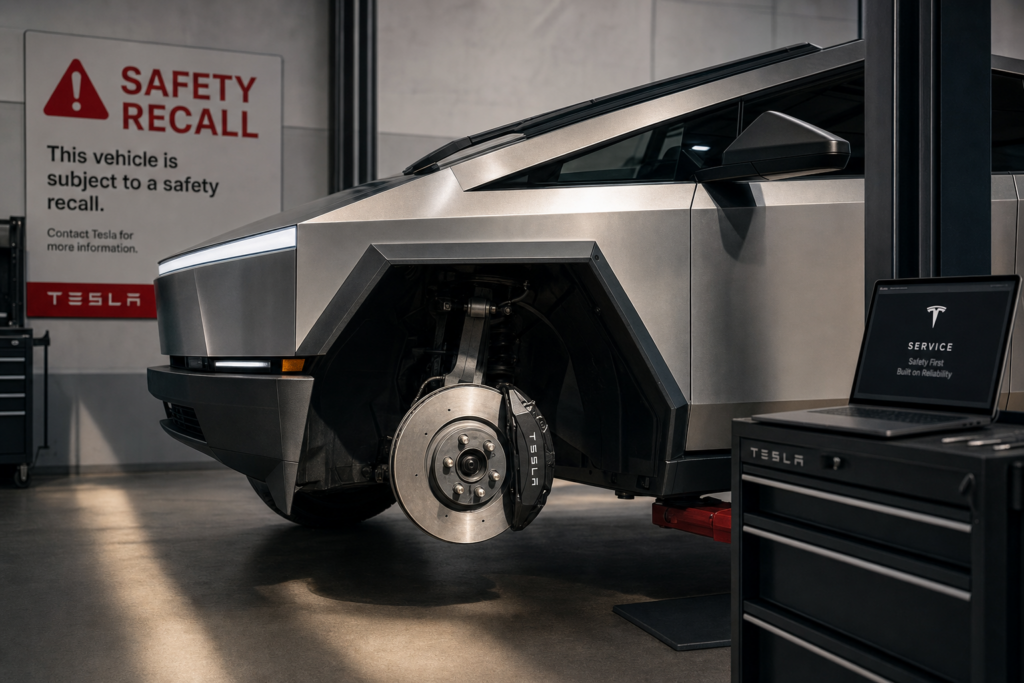
Tesla is recalling 173 Cybertruck vehicles from model years 2024 through 2026 because of a defect that could allow wheel studs to separate from the hub, potentially causing a wheel to detach while the truck is in motion. The recall, designated by federal regulators as 26V255, covers trucks equipped with the optional 18-inch steel wheels and was filed with the National Highway Traffic Safety Administration in early May 2026.
The mechanical problem centers on the brake rotors. According to the NHTSA filing, severe road conditions and cornering put strain on the stud holes in the wheel rotor, which can cause cracks to form. If those cracks spread with continued driving, a stud could eventually separate from the wheel hub entirely. Federal regulators noted in the filing that wheel stud separation may affect vehicle controllability, raising the risk of a collision. Drivers with affected trucks may notice vibration or unusual noise from the wheels before a stud failure occurs.
Tesla traced the root cause to a change management error that occurred when production of the affected vehicles began on August 28, 2025. Engineers had previously identified rotor cracking during pre-production testing earlier that year and were developing a durability fix, but that improvement was not incorporated at the start of production. The company said no studs actually separated during the pre-production testing phase, and no loss of vehicle control was observed at that stage.
The issue surfaced in the field in November 2025, when Tesla identified a service visit from October in which a Cybertruck driver reported braking pulsations. An inspection found cracks on the brake rotor faces. As of mid-April 2026, Tesla had identified three warranty claims potentially connected to the same condition, though the company said it has no confirmed reports of related accidents, injuries, or fatalities. Production of vehicles with 18-inch steel wheels stopped in November 2025, with Tesla noting in the NHTSA filing that the configuration saw limited market demand.
Tesla’s remedy for all 173 affected vehicles is replacement of the front and rear brake rotors, hubs, and lug nuts at no cost to owners. All Tesla service centers were notified of the recall on April 20, 2026. Owner notification letters are scheduled to be sent in June 2026. Owners who experience wheel vibration or noise before receiving notification are advised to contact a Tesla service center.
The 18-inch steel wheel configuration was offered exclusively on the rear-wheel-drive Cybertruck, which Tesla launched in April 2025 as a lower-priced entry point before discontinuing the option in November. The 173 units subject to the recall represent a fraction of total Cybertruck production, reflecting the modest uptake of that particular wheel package.
The latest action brings the Cybertruck’s recall total to at least 11 separate campaigns since the electric pickup’s debut in late 2023. Prior campaigns addressed issues ranging from a loose accelerator pedal trim piece to windshield-side stainless steel trim panels that could detach at highway speed. A March 2025 recall covered more than 46,000 Cybertrucks over a panel-adhesive failure that posed a road hazard to following motorists. A separate recall issued days before the wheel stud action covered more than 218,000 Tesla vehicles over a rearview camera defect.
For the Upstate South Carolina automotive manufacturing ecosystem, quality and safety recall patterns at major automakers carry direct supply-chain relevance. BMW Manufacturing in Spartanburg County — the single largest U.S. automotive exporter by value — operates one of the most scrutinized quality systems in the industry, with supplier networks that include brake and chassis component makers across the region. Tier-one and tier-two suppliers serving the Upstate’s automotive cluster, including seating and structural systems producers such as Adient and Magna International facilities in the region, monitor industry-wide recall patterns to benchmark their own quality assurance and gauge the precision tolerances demanded by automakers.
Tesla’s acknowledgment that a planned engineering fix was not incorporated at production launch because of an internal change management failure underscores a recurring challenge across the industry: ensuring that pre-production engineering decisions transfer cleanly into the production line. For suppliers and manufacturers in the Greenville-Spartanburg corridor, that kind of process discipline is a core competitive requirement to retain business from the region’s major automotive clients.
Owners of 2024-2026 Cybertrucks with 18-inch steel wheels can check their vehicle identification number against the recall using the NHTSA recall database at nhtsa.gov or contact Tesla directly for service scheduling. Tesla is required by federal law to perform the repairs at no charge.