Alabama Gov. Kay Ivey signed legislation Friday that would wipe out results from the state’s May 19 congressional primary and order a new election under redrawn district lines — but only if federal courts first agree to lift an existing injunction barring those new maps from taking effect.
The law is part of a coordinated push by Republican-led legislatures across the South to capitalize on a recent U.S. Supreme Court decision in a Louisiana case that significantly weakened Voting Rights Act protections for racial minorities. In Alabama, the legislation passed during a special legislative session and was sent to Ivey within hours of clearing the statehouse floor.
Under the new law, the May 19 primary results for several congressional seats would be set aside and the governor would be directed to schedule a replacement primary under GOP-drawn district boundaries. Alabama lawmakers also approved a companion measure that would apply the same logic to state Senate districts.
The special primary would only take place if courts lift an injunction that has kept a court-selected map in place since a federal panel rejected Alabama’s 2023 redistricting plan. That court-imposed map required the creation of a second congressional district in which Black voters are the majority or near it — a requirement that led to the 2024 election of Democratic Rep. Shomari Figures, who is Black. Republican officials want to replace the court map with the 2023 plan, which they believe could enable them to retake Figures’ seat.
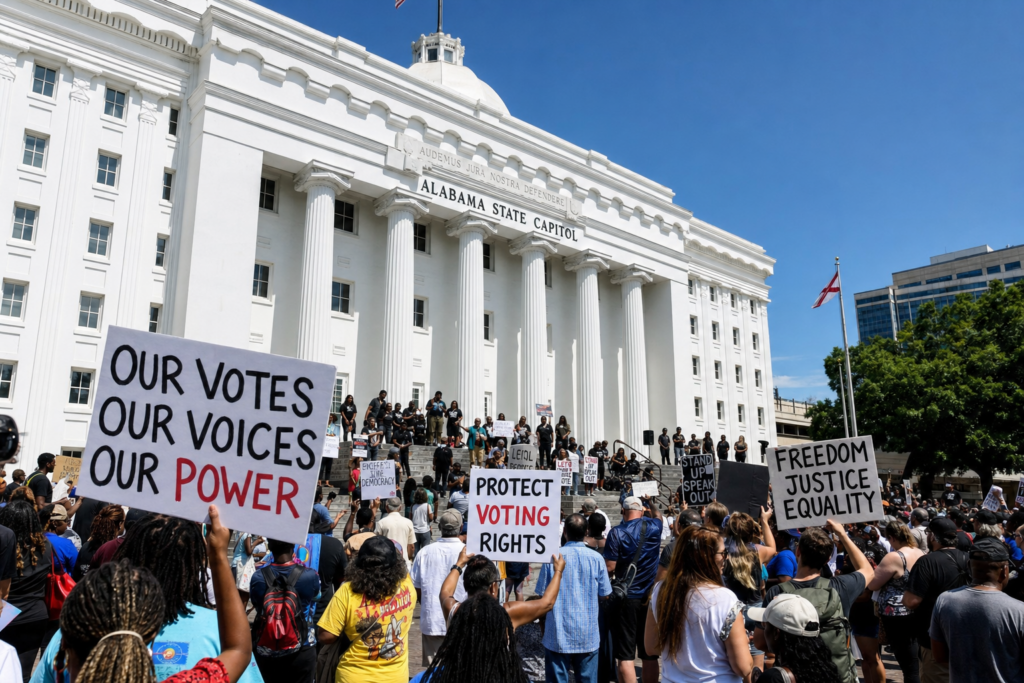
The special session drew heated opposition inside and outside the Alabama Statehouse. Demonstrators gathered outside shouted slogans opposing the redistricting effort, while one protester was dragged from the packed House gallery by security officers. On the Senate floor, Democratic members shouted in protest during the vote. Democratic state Sen. Rodger Smitherman said the passage of the legislation set the state back to the era of Reconstruction. Civil rights advocate Betty White Boynton, who said she marched for voting rights in 1965, was among those who spoke out against the measure.
By Friday evening, a three-judge federal panel rejected Alabama’s request to lift the injunction and clear the way for its new maps. Alabama’s petition to the U.S. Supreme Court on the same question remains pending, meaning the law Ivey signed could still be triggered if the high court acts favorably.
Ivey said completing the special session put Alabama in a position to act quickly if courts cooperate. Republican state Sen. Greg Albritton told colleagues that if no court order is issued, the new law will have no effect whatsoever on the May 19 primary.
South Carolina in the Same Fight
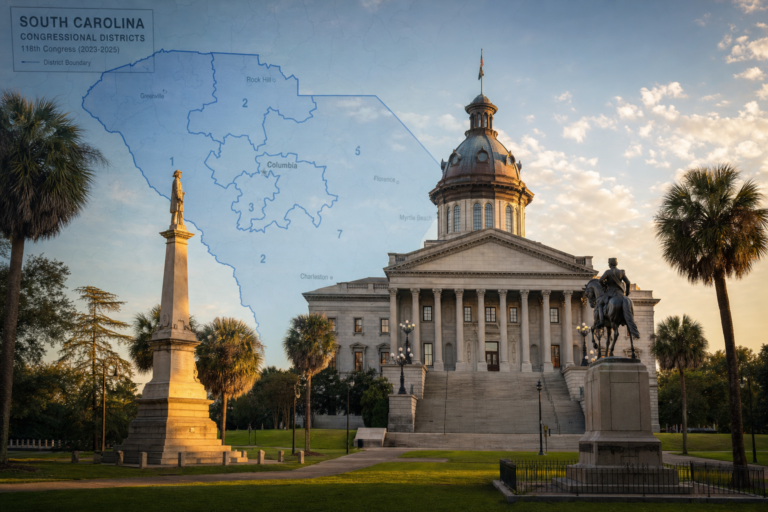
While Alabama’s legislature was moving through its special session, South Carolina lawmakers held their own rare Friday meeting to consider a proposed new congressional map that would give Republicans all seven of the state’s U.S. House seats. That proposal would break up the 6th Congressional District currently held by Democratic Rep. James Clyburn, who has represented the district since 1993 and serves as a senior member of the House Appropriations Committee.
The Friday hearing in Columbia was described as only a first step. South Carolina’s state Senate would still need a two-thirds vote to agree to take up redistricting at all. A legislative subcommittee did advance a plan to delay the state’s June 9 congressional primary to August and reopen the candidate filing period, if a new map is ultimately approved. Some absentee ballots for the June 9 elections had already been returned when the Friday meeting occurred.
A consultant hired to review the proposed South Carolina map told the subcommittee it appeared legally permissible under the Supreme Court’s recent Louisiana decision. Democratic state Rep. Justin Bamberg acknowledged the legal latitude but questioned whether legal permission makes the action right.
Civil rights activists and Democrats attending the South Carolina hearing offered near-universal opposition testimony. The redistricting effort drew criticism for threatening to dilute Black voter influence in the Upstate SC and Lowcountry regions anchored by Clyburn’s district.
Rep. William Timmons, whose SC-4 district covers the Greenville-Spartanburg corridor, sits on the House Financial Services and Oversight committees. His district would not be directly eliminated under the current proposals, but a Republican sweep scenario would reshape the composition and partisan arithmetic of the full South Carolina delegation in ways that touch federal appropriations, trade policy, and economic development funding that flows to the Upstate.
The broader national redistricting moment is moving quickly. Virginia’s Supreme Court on Friday struck down a redistricting amendment that had been approved by voters in April, ruling that the legislature’s initial approval came too late — during a period when more than 1.3 million ballots had already been cast. Tennessee had already enacted new congressional maps carving up a Democratic-held, majority-Black district in Memphis, and the state Democratic Party filed suit Friday to block those maps before the 2026 elections. In Louisiana, a Senate committee was simultaneously considering options to eliminate one or both of the state’s current Black-majority congressional districts, with Republican Sen. John Morris leading that effort.
The Supreme Court ruling that set all of this in motion came in a Louisiana case that narrowed the legal framework courts must use to evaluate racial minority voting power. For decades, that framework had been a primary mechanism by which majority-minority districts were created and protected across Southern states. With that framework now weakened, Republican legislators in multiple states are moving simultaneously to redraw maps before November.